
CORE Releases New Guidance on Contact Lens Handling and Dropout Prevention
Thursday, October 15 2026 | 13 h 12 min | News
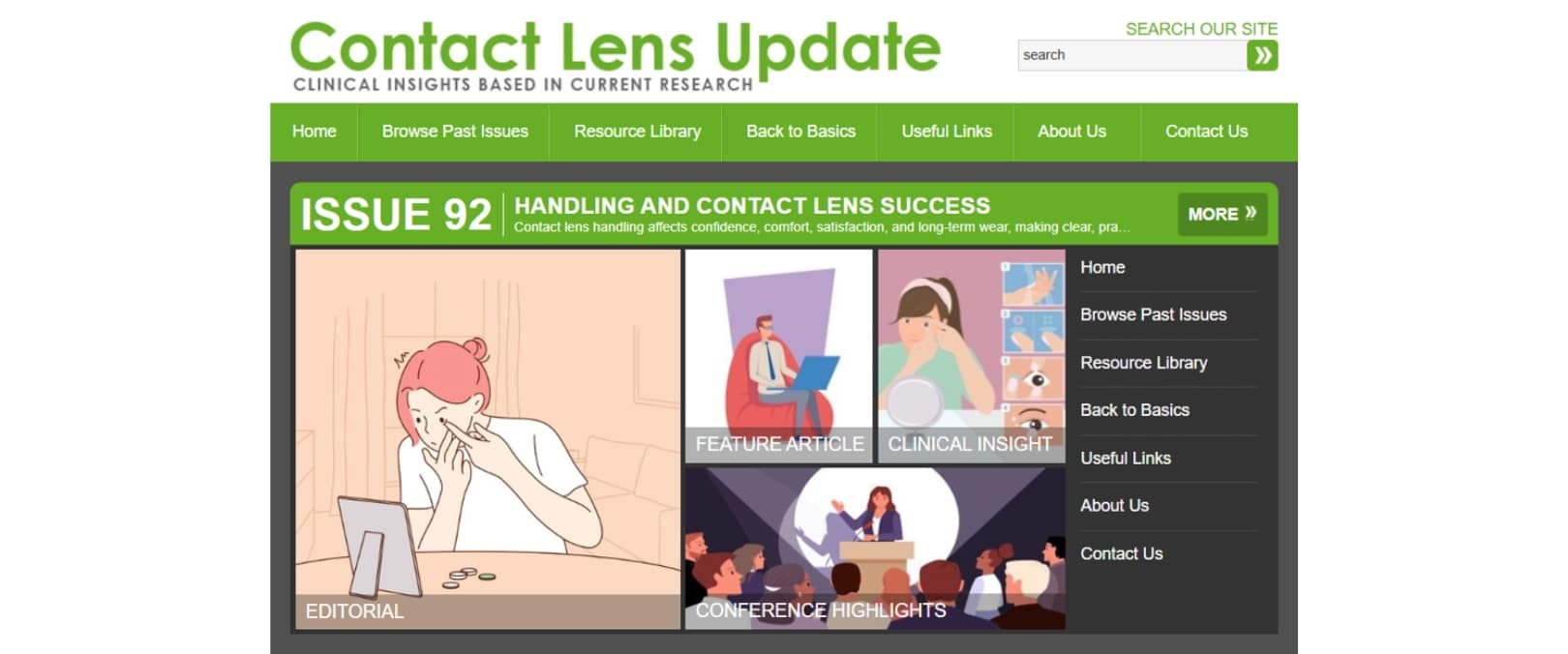
The Centre for Ocular Research & Education (CORE) has published Issue 92 of Contact Lens Update, focusing on the role of contact lens handling in successful wear and its influence on patient dropout. The bi‑monthly publication is available free of charge at ContactLensUpdate.com.
Handling remains a critical part of the contact lens experience, influencing patient confidence, satisfaction and long‑term success. Difficulties with application, removal or lens care can lead to frustration and, in some cases, discontinuation. According to Daddi Fadel, adjunct assistant professor at the University of Waterloo and consultant for CORE, clear and practical handling education should be considered an essential component of contact lens care.
Exploring Handling Challenges and Dropout Drivers
The opening editorial, co‑authored by Meredith Bishop, OD, MS, FAAO (Director of Global Medical Education, Vision, Johnson & Johnson) and Stephanie Wong (clinical scientist at CORE and associate editor of Contact Lens Update), examines how handling difficulties contribute to dropout. The authors outline strategies for tailored training, patient education and ongoing support to promote successful, sustained wear.
The feature article, written by Sebastian Marx, optometrist, professor and researcher at the JENVIS Research Institute in Germany, reviews the primary causes of contact lens dropout — including visual dissatisfaction, handling challenges, discomfort and ocular surface disease — and highlights approaches to improve retention and re‑engage former wearers.
Practical Clinical Tools and New Research Insights
CORE’s clinical insight section offers practitioners a practical video series demonstrating step‑by‑step handling techniques for corneal, soft and scleral lenses. The videos cover insertion, removal, cleaning and safe lens care, translating essential techniques into clear, clinically useful guidance to help patients build confidence and establish consistent routines.
The conference highlight, authored by Anna Sulley, optometrist and Visiting Research Fellow at Aston University, presents findings from a study comparing spherical and toric daily disposable lenses made from the same material. Over 10 hours of wear, both lens types showed similar comfort, wettability, fitting, handling and chair time.

ContactLensUpdate.com also provides a complete archive of past issues and a resource library offering free professional tools, patient materials, images, videos and technical training content produced by the International Association of Contact Lens Educators, along with an industry glossary. Visitors can access Issue 92 directly or sign up for email delivery of future editions.
The publication is supported by the educational divisions of Alcon, CooperVision and Johnson & Johnson Vision.
Source: Centre for Ocular Research & Education
Want to see more like this article? Click here to subscribe to our FREE print magazines and e-newsletters!