
fbpx
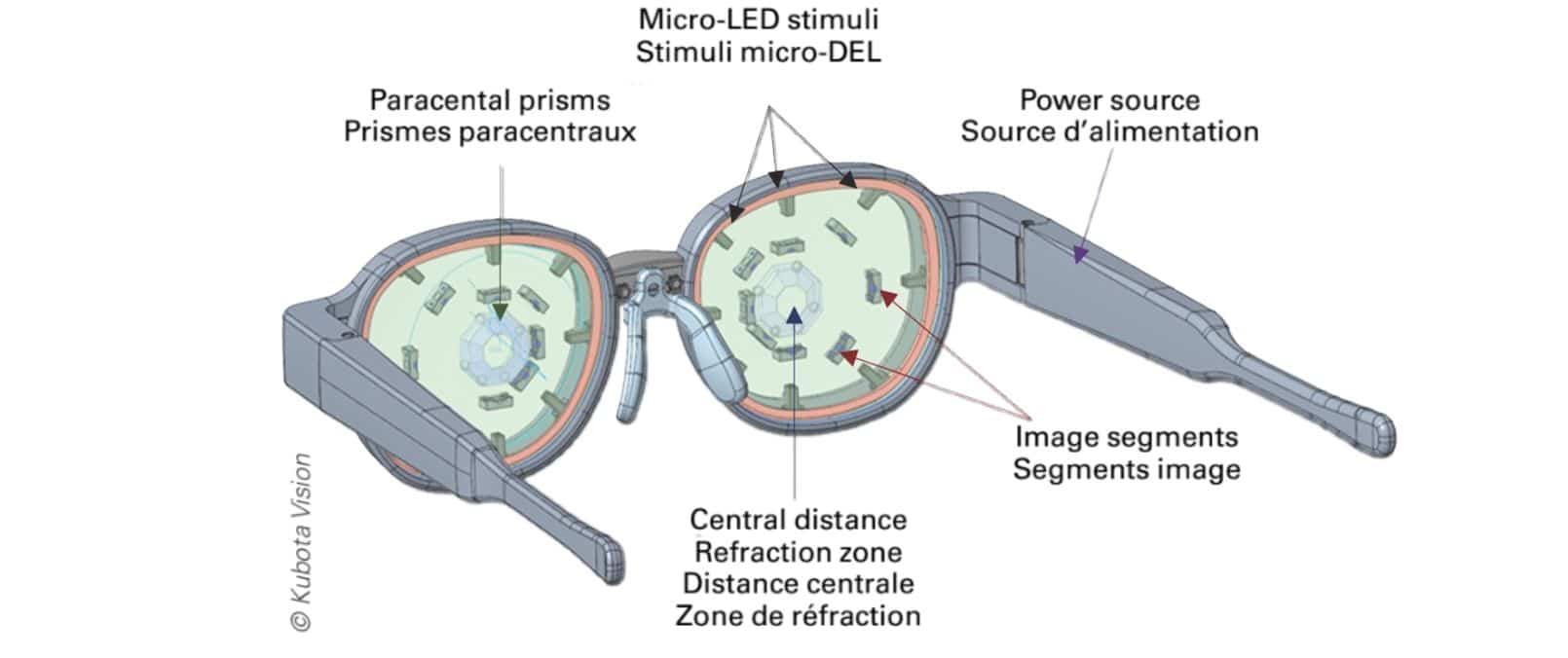
Illustration of the Kubota Glass device, developed for managing childhood myopia. The device looks like a large, thick rimmed and thick-lensed pair of glasses. Labeled parts include the Paracental prisms, Micro-LED stimuli, Power source, Image segments, and Central distance refraction zone. There are also labels in French.

Childhood Myopia (part 3 of 4)

By Thomas Weissberger, RO

Why is peripheral defocus an effective treatment for managing childhood myopia?

If we think back to basic optics, we remember that light from a close object is diverging as it enters the eye, as opposed to light from a distant object which enters the eye in parallel rays. Although the central wave of light can still focus on the macula (depending on whether there is already an ametropia present), light in the periphery focuses behind the retina.
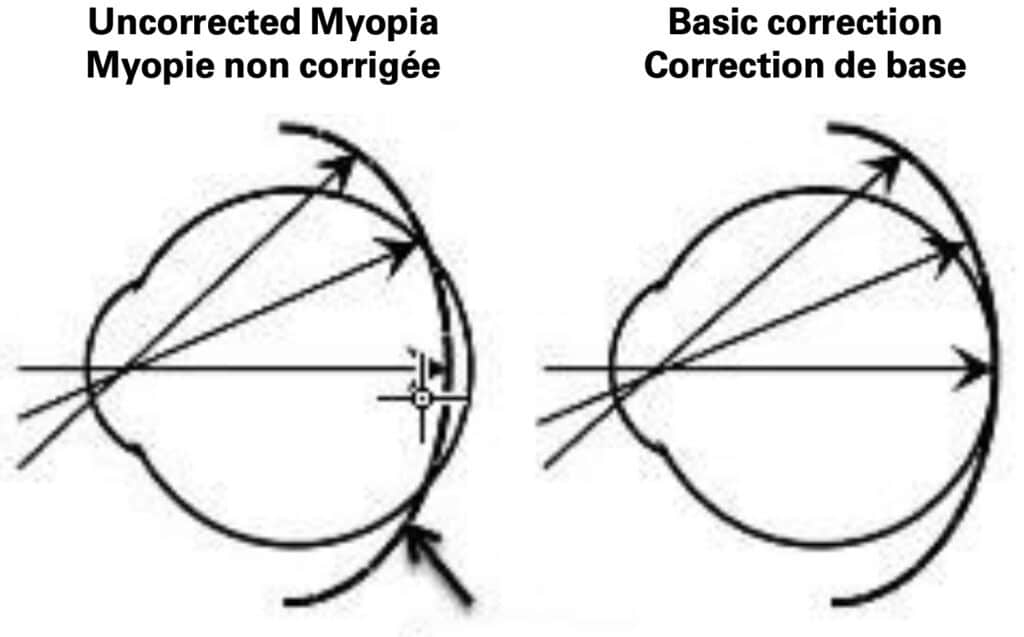
A diagram showing light rays entering two eyes. The left image, labeled "Uncorrected Myopia," depicts light rays focusing in front of the retina, illustrating uncorrected myopia. The right image, labeled "Basic correction," shows light rays focusing on the retina, illustrating basic correction. Corrective lenses are a basic method of managing childhood myopia. All of the text also appears in French.

When vision is corrected with normal single vision minus lenses, the peripheral light rays focus even further behind the retina. This triggers the brain to increase the length of the eyeball through growth so that light will return to focus in the periphery, which in turn increases the amount of myopia. This continual cycle generates the issue we face today.

Animal research has established that both defocus and contrast visual signals influence ocular growth and refractive development. Other theories of myopia development, progression and control include the peripheral defocus and simultaneous defocus theories. What these theories have in common is that optical defocus is identified as a driver to eye growth: hyperopic defocus accelerates while myopic defocus slows eye growth. Defocus drives the eye to grow, or to stop growing, to find the point of focus.

Peripheral defocus is well understood, while the newer theory of simultaneous defocus can be pictured as on or off-axis, where opposing defocus signals compete to signal eye growth. Examples of myopia control treatments employing simultaneous defocus are the MiSight® 1 day dual-focus contact lens, and the Defocus Incorporate Multiple Segments (D.I.M.S.) and Highly Aspherical Lenslet Target (H.A.L.T.) Technology spectacle lenses; as well as C.A.R.E ® (Cylindrical Annular Refractive Elements).

HALT vs DIMS vs DOTS vs CARE: What does it all mean?

What do all these acronyms stand for, and why are they important? Think of DIMS and HALT technology as a single vision lens for myopia correction, with an overlaying ‘treatment zone’ for myopia control.

The largest lens suppliers use different technology to try and achieve the same goal of managing childhood myopia. I am not going to define one as being better than the other, that is for you to decide as eye care professionals, but you must know the difference.

HALT stands for Highly Aspheric Lenslet Targets. The basis of this technology in the Essilor® Stellest™ lens is a high volume of very small lenslets arranged in concentric rings that create a volume of defocus, the lenselets focusing light in front of the mid-peripheral retina.
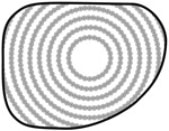
This image depicts a series of concentric circles representing the arrangement of lenslets in the Stellest™ lens design, which is used for managing childhood myopia.
Representation of lenslet positioning in Stellest™

As always Multi AR is recommended on the lenses to improve clarity of vision.

DIMS stands for Defocus Incorporated Multiple Segments; the idea being that a group of lenslets arranged in a very specific pattern will result in both mid-peripheral defocus, and a reduction in contrast. DIMS technology is used by Hoya in their MiyoSmart lenses (currently available in Canada, but not FDA approved). The multiple segments are arranged in very specific patterns to ensure clarity of central vision along with the benefits of peripheral defocus. And as outdoor wear is so important, to promote eye protection, MiyoSmart will soon be released in a photochromic version called Chameleon®.
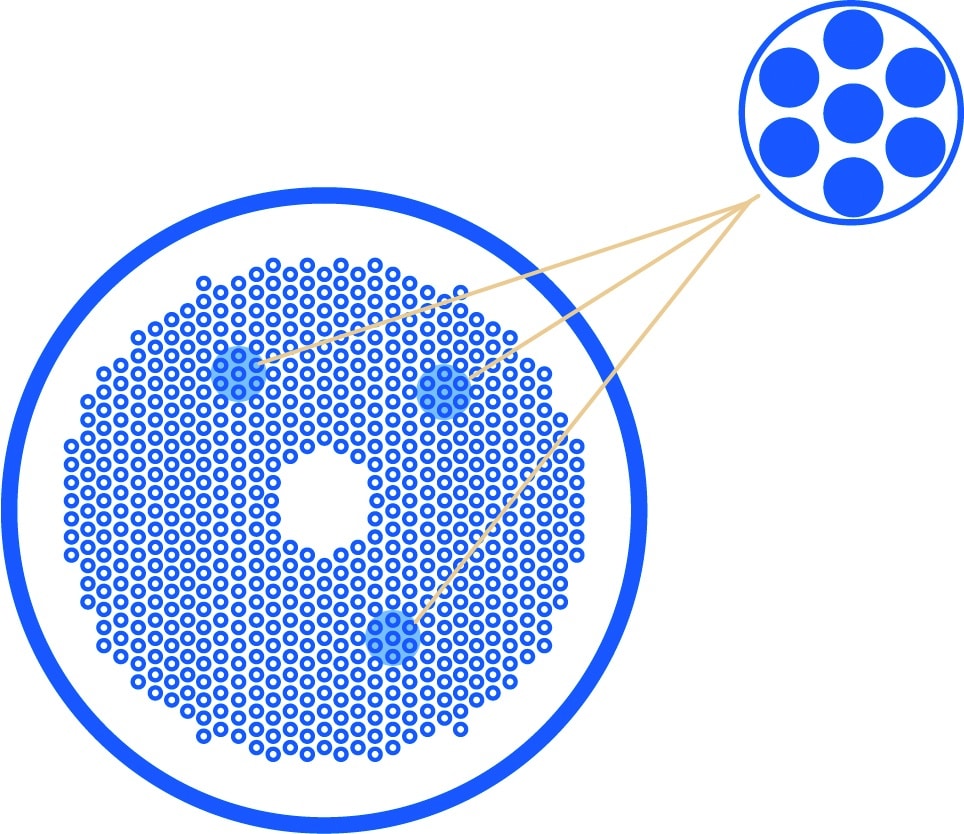
This image shows a circular arrangement of numerous small lenslets with an inset zoomed-in view of a few individual lenslets arranged in a hexagonal pattern.
Representation of lenslet spacing in MiyoSmart

CARE® lenses from ZEISS are based on annular rings rather than lenselets to achieve a peripheral defocus effect.

What Is the Contrast Theory and how does it relate to managing childhood Myopia?

Contrast is an important aspect of the visual experience. It is the ability of the eye to distinguish differences in luminance, which is essential for object recognition.

Contrast theory hypothesizes that myopia arises from the amount of retinal stimulation that occurs. High contrast images cause high retinal stimulation; low contrast images cause low retinal stimulation. It is thought that overstimulation of the retina from high contrast is associated with overstimulation of eye growth, thus instigating myopia progression.

DOT format

The DOT (Diffusion Optics Technology™) format is used by SightGlass, a joint venture between EssilorLuxottica and CooperVision.

The SightGlass DOT lens is designed to slightly reduce and modulate (i.e. ‘even out’) retinal contrast by scattering light, in order to lower the signal for eye elongation and myopia progression. The treatment zone of DOT lenses incorporates microdots that softly disperse any light that passes through it, thereby modulating contrast. These microscopic diffusers are about one tenth of a millimetre wide.

The microdots are not designed to produce peripheral defocus: the main goal is to slightly lower retinal contrast irrespective of viewing distance. These microdots encompass most of the lens, except for a small portion (around 5mm diameter) in front of the pupil that provides uninterrupted, clear vision. This does not mean that the wearer is only given a small portion of lens to look through: in fact, the wearer is still able to look through any portion of the lens. When looking through the treatment zone, the images have a softer appearance without losing detail.

Kubota Glass™

Finally, a novel approach to managing childhood myopia: Kubota Glass™ has been created by Kubota Vision Inc. an ophthalmological and medical company based in Japan. The theory is also based on contrast reduction theory, using micro-LEDs arranged in a concentric pattern aimed at the mid-periphery of the retina. The LEDs shine a light on the retina to reduce perceived contrast. Although somewhat ungainly looking, Kubota states that unlike other solutions, this wearable device only needs to be worn two to four hours per day. (Note: Currently only available in Japan.)


The Practical Professor: Optical Solutions for the Real World

I am a second generation optician and have made all aspects of opticianry and optics my life. I have over 10 years of teaching experience as a former professor in the Dispensing Opticians’ program at Seneca College and at Georgian College. I was also responsible for
modernization of the optical curriculum.

I am a trainer and trainee (One never stops learning!), and I am available to share my knowledge and experience with today’s eye care professionals. As the owner of Special Eyes Optical Services, I am dedicated to supporting the optical industry. You can reach out to me at Tom@SpecialeyesOpticalServices.com.

Want to see more like this article? Subscribe to our FREE print magazines and e-newsletters!
Featured Posts

Optik Voilàs November-December 2025- COS Silhouette SPX_Illusion_2978_5530

SPX Illusion 2025: Lightness Meets Bold Style

Silhouette unveils SPX Illusion 2025, featuring two new lightweight shapes— including a striking geometric design—offered in five trend-forward colors like Canary Green Havana and Smokey Blossom. A refined, featherlight way to express personal style with elegance.

Learn More
EssilorLuxottica

EssilorLuxottica Expands Ophthalmology Footprint with Acquisition of Signifeye

EssilorLuxottica will acquire Signifeye, adding 15 Belgian clinics to its growing ophthalmology network and strengthening its integrated medical eye-care strategy.

Read more
Centre for Ocular Research & Education (CORE)

CORE Summarizes TFOS DEWS III Reports to Boost Dry Eye Knowledge

CORE has published issue 87 of Contact Lens Update, summarizing key findings from the TFOS DEWS III dry eye reports. Expert-authored content and downloadable PDFs provide clinicians with practical guidance on diagnosis, management, and evolving best practices.

Read more
contact lens institute

Contact Lens Institute Announces 2025 Culture Award Honorees

The Contact Lens Institute has named its 2025 Culture Award honorees, recognizing U.S. and Canadian eye care professionals advancing contact lens culture.

Read more
National Association of Optical Goods Manufacturers ANFAO logo

ANFAO Outlines Strategy for Italian Eyewear Industry Amid Global Market Pressures

ANFAO outlines its 2025–2026 strategy for the Italian eyewear industry, balancing identity, innovation and global market expansion.

Read more
Optik Voilàs November-December 2025- COS Silhouette SPX_Illusion_2978_5530

SPX Illusion 2025: Lightness Meets Bold Style

Silhouette unveils SPX Illusion 2025, featuring two new lightweight shapes— including a striking geometric design—offered in five trend-forward colors like Canary Green Havana and Smokey Blossom. A refined, featherlight way to express personal style with elegance.

Learn More
EssilorLuxottica

EssilorLuxottica Expands Ophthalmology Footprint with Acquisition of Signifeye

EssilorLuxottica will acquire Signifeye, adding 15 Belgian clinics to its growing ophthalmology network and strengthening its integrated medical eye-care strategy.

Read More
Centre for Ocular Research & Education (CORE)

CORE Summarizes TFOS DEWS III Reports to Boost Dry Eye Knowledge

CORE has published issue 87 of Contact Lens Update, summarizing key findings from the TFOS DEWS III dry eye reports. Expert-authored content and downloadable PDFs provide clinicians with practical guidance on diagnosis, management, and evolving best practices.

Read More
contact lens institute

Contact Lens Institute Announces 2025 Culture Award Honorees

The Contact Lens Institute has named its 2025 Culture Award honorees, recognizing U.S. and Canadian eye care professionals advancing contact lens culture.

Read More
National Association of Optical Goods Manufacturers ANFAO logo

ANFAO Outlines Strategy for Italian Eyewear Industry Amid Global Market Pressures

ANFAO outlines its 2025–2026 strategy for the Italian eyewear industry, balancing identity, innovation and global market expansion.

Read More
Optik Voilàs November-December 2025- COS Silhouette SPX_Illusion_2978_5530

SPX Illusion 2025: Lightness Meets Bold Style

Silhouette unveils SPX Illusion 2025, featuring two new lightweight shapes— including a striking geometric design—offered in five trend-forward colors like Canary Green Havana and Smokey Blossom. A refined, featherlight way to express personal style with elegance.

Learn More
EssilorLuxottica

EssilorLuxottica Expands Ophthalmology Footprint with Acquisition of Signifeye

EssilorLuxottica will acquire Signifeye, adding 15 Belgian clinics to its growing ophthalmology network and strengthening its integrated medical eye-care strategy.

Read more
Centre for Ocular Research & Education (CORE)

CORE Summarizes TFOS DEWS III Reports to Boost Dry Eye Knowledge

CORE has published issue 87 of Contact Lens Update, summarizing key findings from the TFOS DEWS III dry eye reports. Expert-authored content and downloadable PDFs provide clinicians with practical guidance on diagnosis, management, and evolving best practices.

Read more
contact lens institute

Contact Lens Institute Announces 2025 Culture Award Honorees

The Contact Lens Institute has named its 2025 Culture Award honorees, recognizing U.S. and Canadian eye care professionals advancing contact lens culture.

Read more
National Association of Optical Goods Manufacturers ANFAO logo

ANFAO Outlines Strategy for Italian Eyewear Industry Amid Global Market Pressures

ANFAO outlines its 2025–2026 strategy for the Italian eyewear industry, balancing identity, innovation and global market expansion.

Read more
Optik Voilàs November-December 2025- COS Silhouette SPX_Illusion_2978_5530

SPX Illusion 2025: Lightness Meets Bold Style

Silhouette unveils SPX Illusion 2025, featuring two new lightweight shapes— including a striking geometric design—offered in five trend-forward colors like Canary Green Havana and Smokey Blossom. A refined, featherlight way to express personal style with elegance.

Learn More
EssilorLuxottica

EssilorLuxottica Expands Ophthalmology Footprint with Acquisition of Signifeye

EssilorLuxottica will acquire Signifeye, adding 15 Belgian clinics to its growing ophthalmology network and strengthening its integrated medical eye-care strategy.

Read more
Centre for Ocular Research & Education (CORE)

CORE Summarizes TFOS DEWS III Reports to Boost Dry Eye Knowledge

CORE has published issue 87 of Contact Lens Update, summarizing key findings from the TFOS DEWS III dry eye reports. Expert-authored content and downloadable PDFs provide clinicians with practical guidance on diagnosis, management, and evolving best practices.

Read more
contact lens institute

Contact Lens Institute Announces 2025 Culture Award Honorees

The Contact Lens Institute has named its 2025 Culture Award honorees, recognizing U.S. and Canadian eye care professionals advancing contact lens culture.

Read more
National Association of Optical Goods Manufacturers ANFAO logo

ANFAO Outlines Strategy for Italian Eyewear Industry Amid Global Market Pressures

ANFAO outlines its 2025–2026 strategy for the Italian eyewear industry, balancing identity, innovation and global market expansion.

Read more