

Orthokeratology’s 70-Year Legacy Celebrated with Launch of Ortho-k Pioneers Award
Monday, November 2 2026 | 10 h 17 min | News
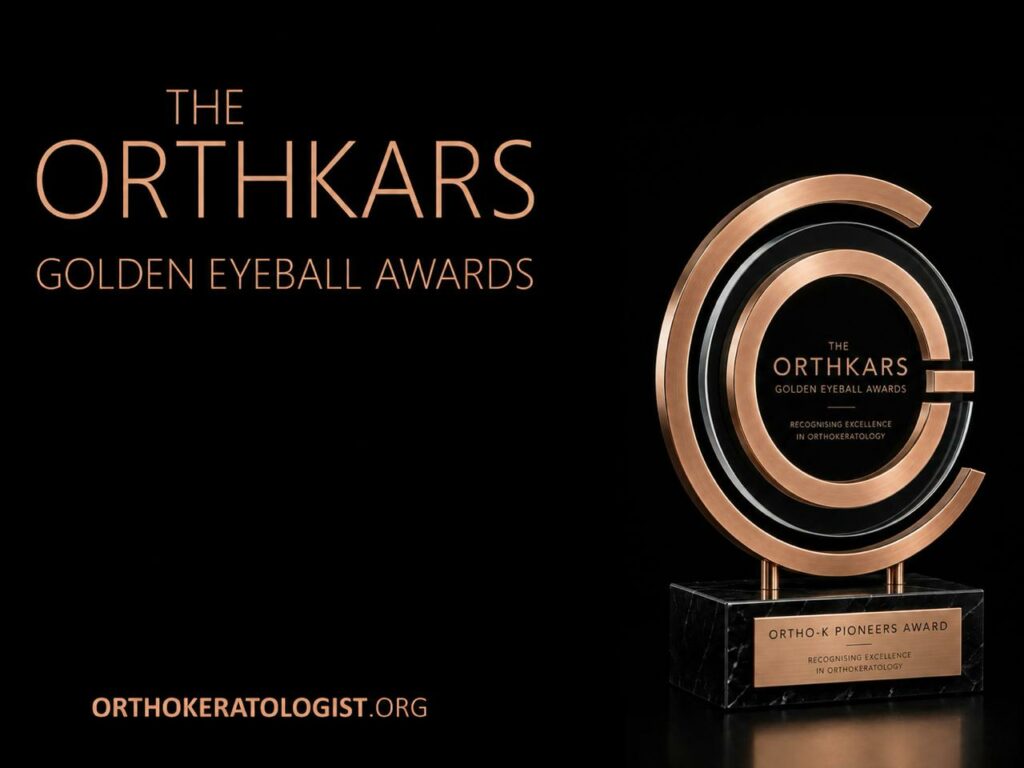
As orthokeratology marks its 70th anniversary in 2026, Orthokeratologist.org has launched a new Ortho-k Pioneers Award to recognize the individuals whose innovations helped shape the specialty and advance myopia management worldwide.
The award is being introduced as part of The Orthkars | Golden Eyeball Awards, an initiative designed to celebrate the history, evolution and future of orthokeratology while highlighting the practitioners and innovators who have contributed to its growth.
The announcement coincides with the publication of a new 10-part historical series on Orthokeratologist.org, authored by co-founder and orthokeratologist Jaimin Patel, documenting the origins of ortho-k and the often-overlooked pioneers who helped establish the field.
Honouring the pioneers of orthokeratology
According to Patel, the roots of orthokeratology can be traced back to 1956, when Dr. Robert Morrison published a landmark study demonstrating that rigid contact lens wear could halt myopia progression in teenagers over a two-year period.
“George Jessen is usually incorrectly credited as the founder of ortho-k,” said Patel. “While he created the first ‘orthofocus’ lenses in the early 1960s, it was Dr. Robert Morrison’s landmark study in 1956 that discovered the ‘orthofocus’ technique upon which Jessen’s lenses were based.”
Patel noted that although Jessen played a significant role in developing early orthokeratology lenses, the story of ortho-k extends far beyond a single individual and includes numerous innovators whose contributions have largely remained untold.
The historical series explores the experiences of practitioners who manufactured their own orthokeratology lenses in the 1970s, the introduction of corneal topography into clinical practice and the development of rigid gas permeable (RGP) lens materials that helped advance the field.
How orthokeratology got its name
The series also highlights the contribution of Newton Wesley, who proposed the term “orthokeratology” during a contact lens specialists’ conference in Chicago in 1962.
Patel explained that the term derives from Greek words meaning the practice of correcting the shape of the cornea and ultimately replaced Jessen’s earlier “orthofocus” terminology.
Wesley’s broader influence on the eye care profession extended beyond orthokeratology. A strong advocate for clear patient communication, he championed the adoption of simple, accessible terminology and successfully campaigned to have the term “contact lens” included in the dictionary, helping establish it as a widely recognized consumer term.
Looking ahead to the next generation of innovators
For Deven Lakhani, orthokeratologist and co-founder of Orthokeratologist.org, the new Ortho-k Pioneers Award is intended to recognize both the profession’s historical figures and today’s leaders in innovation.
“The Ortho-k Pioneers Award is a fitting way to not only celebrate the original trailblazers and those who boldly followed in their footsteps, but to showcase the current pioneers who sit on the leading edge of ortho-k innovation and are writing the next chapter of this incredible story we’re proud to be part of,” said Lakhani.
He also pointed to the increasing use of the term “night lenses” as a more consumer-friendly alternative to orthokeratology, reflecting ongoing efforts to improve public understanding and adoption of the category.
As the profession celebrates 70 years since Morrison’s pioneering research, the new award and historical archive aim to preserve the legacy of orthokeratology while recognizing the practitioners who continue to shape its future.
Source: Orthokeratologist.org
Want to see more like this article? Click here to subscribe to our FREE print magazines and e-newsletters!