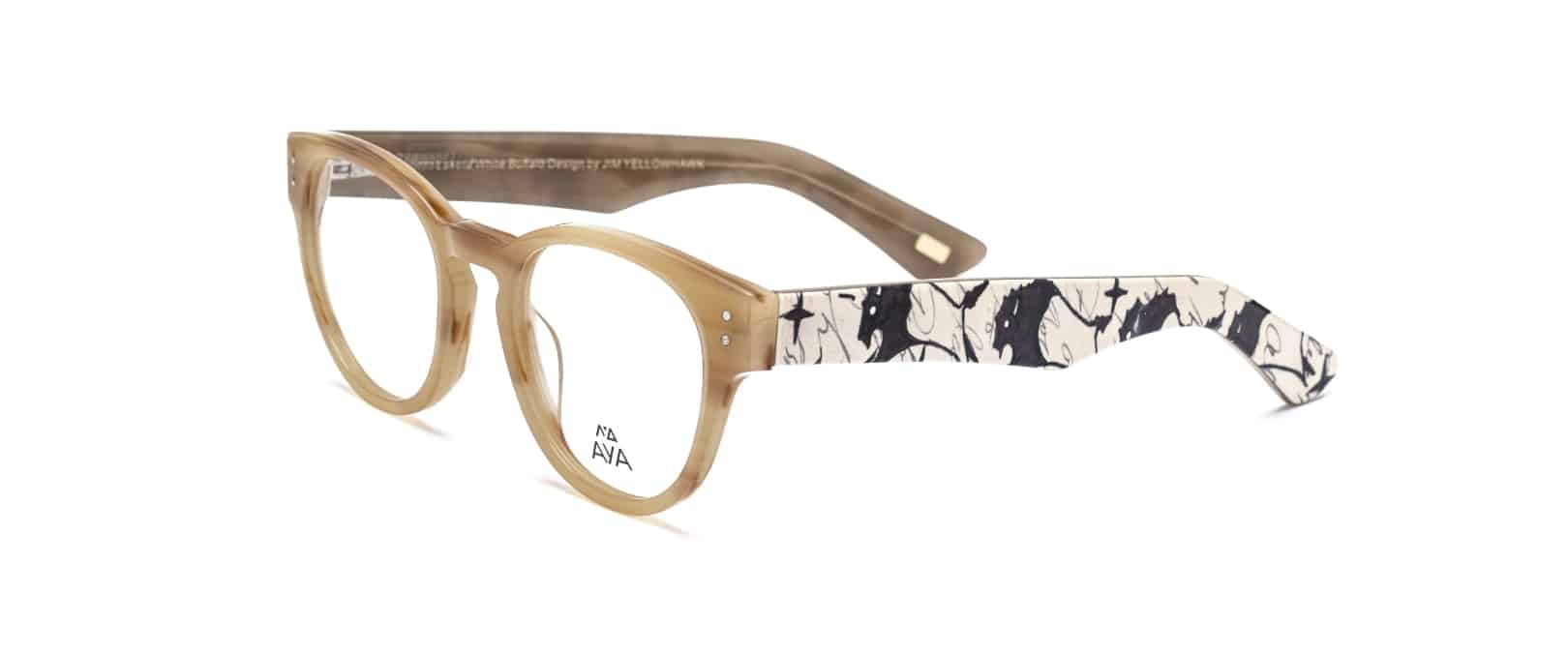
AYA Optical x Lakota Artist Yellowhawk AYA Optical proudly introduces Cetangi, the latest eyewear style featuring Jim Yellowhawk’s White Buffalo design. Inspired by Lakota culture, the sacred buffalo symbolizes abundance, resilience, and unity. Cetangi—meaning Yellowhawk in Lakota—blends artistic heritage with modern fashion, making it a meaningful and stylish choice.
We believe that art is transformative, and that eyewear can be the canvas to share stories and art from around the world. AYA Eyewear was first launched in 2009 in collaboration with renowned First Nations Artist Corrine Hunt and has continued to flourish and grow every year.
We are committed to the details and realize that beautiful design takes time, precision, and attention, so we don’t cut corners. We stand by our product. We treat our artists as our partners and make sure that their stories and art are always shared in the most heartfelt authentic way.
We take pride in our service and seek opportunities to give back to the communities we serve and the artist’s charities of choice.
AYA Eyewear is truly a brand that stands out from the crowd and is loved by Indigenous and non-Indigenous communities alike.
Want to see more like this article? Click here to subscribe to our FREE print magazines and e- newsletters!
EssilorLuxottica unveiled new six-year clinical data at the 2025 China Optometry & Ophthalmology Conference (COOC), reinforcing the long-term efficacy of Essilor Stellest lenses in managing myopia progression and axial elongation in children and young adults. The results underscore the significant and sustained impact of Essilor Stellest lenses in controlling myopia progression, offering valuable insights into strategies for addressing the global myopia epidemic.
The findings were presented for the first time during a dedicated satellite session at COOC 2025 by Prof. Jinhua Bao from the Eye Hospital of Wenzhou Medical University (China), the principal investigator of the clinical trial. The study began in 2018 with children aged between 8 and 13 years old. After completing the initial five-year phase, participants continued wearing Essilor Stellest lenses for an additional two years to assess the long-term impact on myopia progression. By the time of the sixth- year follow-up, the participants were aged between 14 and 19 years. The six-year results showed that Essilor Stellest lenses slowed myopia progression by 1.95 D (57%) and slowed axial elongation by
0.81 mm (52%)1, compared to an extrapolated single-vision lens control group* model based on data from the first two years of the clinical trial. The findings demonstrate the continued efficacy of Essilor Stellest lenses, with effects sustained up to 19 years of age.
“The strong response at COOC 2025 highlights the widespread adoption of Essilor Stellest lenses as a trusted, proven tool for ECPs in China and worldwide, supporting long-term myopia management, while addressing the global myopia epidemic,” said Olga Prenat, Head of Medical & Professional Affairs at EssilorLuxottica. “These results reinforce EssilorLuxottica’s commitment to advancing myopia management with innovative solutions that have a lasting impact on children’s long-term eye health.”
In addition, five-year efficacy data recently published in Eye and Visiondemonstrated that Essilor Stellest lenses significantly slowed myopia progression and axial elongation over five years*2, saving an average of three years of myopia development†2,3. The study also showed that the risk of progressing to high myopia (defined as -6 D or worse) dropped from 38% in the extrapolated single-vision lens control group to just 9% in the Essilor Stellest lenses group2. This research further validates the ethical approach of using extrapolated control groups in long-term clinical trials evaluating myopia progression.
Moreover, a new study recently published in Ophthalmic and Physiological Opticscomplements the growing body of evidence on the efficacy of Essilor Stellest lenses, strengthening their role in slowing myopia progression. Conducted in collaboration with Wenzhou Medical University, the study examined the protective impact of Essilor Stellest lenses on peripheral eye length and peripheral refraction in the third year of the clinical trial.
Dr. Björn Drobe, Director, Applied Myopia Research, EssilorLuxottica R&D and one of the authors of the study, commented, “Our new findings demonstrate that switching to or continuing to wear Essilor Stellest lenses not only slows central and temporal elongation of the eye but also positively affects peripheral eye length and refraction. This, combined with our six-year clinical data and other recent studies, marks a significant step forward in understanding the full scope of how Essilor Stellest lenses manage myopia progression, further confirming their long-term efficacy.”
Essilor Stellest lenses provide eye care practitioners with an evidence-backed solution for managing myopia in children and young adults. With robust clinical data supporting their efficacy, these lenses offer a reliable approach for helping families address the challenges of myopia, improving both short- and long-term eye health outcomes.
Notes
Essilor Stellest lenses are currently not available in all countries.
*Compared to the 60-month progression of the extrapolated control group (predicted average annual decrease in SER by 9.7% based on the initial 2-year control group, Smotherman C, et al. IOVS 2023;64:ARVO E-Abstract 811) & Compared to the 60-month progression of the extrapolated control group (predicted average annual decrease in AL by 15% based on the initial 2-year control group, Shamp W, et al. IOVS 2022;63:ARVO E-Abstract A0111)
†The initial 24-month myopia progression of 50 myopic children wearing single vision lenses in the two-year prospective, controlled, randomized, double-masked clinical in Wenzhou China were compared to the 60-month follow-up of 43 children wearing Essilor® Stellest® lenses.
EssilorLuxottica. Myopia control efficacy of spectacle lenses with highly aspherical lenslets: results of a 6-year follow-up study. 2025. Data on file.
Li X, Huang Y, Liu C, Chang X, Cui Z, Yang Q, Drobe B, Bullimore MA, Chen H, Bao J. Myopia control efficacy of spectacle lenses with highly aspherical lenslets: results of a 5-year follow-up study. Eye and Vision. 2025 Mar 5;12(1):10.
Bao J, Huang Y, Li X, Yang A, Zhou F, Wu J, Wang C, Li Y, Lim EW, Spiegel DP, Drobe B, Chen, H. Spectacle lenses with asphe rical lenslets for myopia control vs single-vision spectacle lenses: a randomized clinical trial. JAMA ophthalmology. 2022;140(5):472-8.
Eye on the Industry, a groundbreaking podcast for eyecare professionals, is officially launching with a mission to provide invaluable insights into leadership, industry trends, and all things optical. Hosted by two industry trailblazers, Christine Zeggil and Isabelle Tremblay, who have each spent decades shaping the industry, this podcast will serve as the go-to resource for optometrists, opticians, eyewear retailers, and leaders in optical manufacturing and technology.
With their combined expertise and passion for the field, the hosts bring unparalleled perspectives on the trends, innovations, and challenges transforming the optical industry. Each episode will feature fun, informative and thought-provoking conversations with industry experts, offering listeners a unique opportunity to stay ahead of the curve by having conversations about the topics that matter most.
“We’re creating a space for open dialogue, expert insights, and practical takeaways that will inspire and empower eyecare professionals at every level,” said Christine Zeggil, Eye on the Industry Podcast Co-Founder & Chief Curator of Optical Conversations. “From business strategies, leadership to technological advancements, we aim to tackle the topics shaping the future of optics.”
The debut episode will be recorded in March and published by the middle of April. To amplify its reach, Eye on the Industry is proud to announce a media partnership with Optik, a leading publication in the field.
“Eye on the Industry” brings a fresh and timely perspective to the evolving world of eyecare,” said Shan Khan, Editor-in-Chief of Optik Magazine. “At Optik, we’re proud to support initiatives that spark meaningful conversations, spotlight leadership, and keep professionals connected to the pulse of the industry. This podcast is a welcome addition to the dialogue.”
Whether you’re navigating the latest eyewear trends, developing your leadership expertise, advancing patient care, or driving innovation in optical technology, Eye on the Industry is your essential roadmap to success in a rapidly evolving marketplace.
Podcast Highlights:
• In-Depth Industry Insights: Explore trends, challenges, and opportunities shaping the future of eyecare.
• Expert Guests: Hear from the brightest minds across the optical spectrum, from clinical leaders to tech innovators.
• Practical Takeaways: Gain actionable strategies to implement in your practice, business, or career.
Mark your calendar for the first episode, coming soon!
For more information and updates, follow Eye on the Industry on Instagram, Facebook, LinkedIn or YouTube or visit www.eyeontheindustry.ca .
About the Hosts
As veterans and trailblazers in the optical industry, Christine Zeggil and Isabelle Tremblay have dedicated their careers to driving innovation and helping shape the profession. With decades of combined experience, they bring a wealth of knowledge and a deep passion for elevating the field.
About Christine Zeggil
Christine Zeggil is the Co-Founder & Chief Curator of Optical Conversations at Eye on the Industry Podcast, bringing energy, expertise, and a deep love all things optical to the mic.
With over 30 years of expertise in sales, marketing, leadership, and business development—and 25 years in the optical industry (19 of those with Transitions Optical!)—Christine currently leads as the Manager of National Key Accounts for Canada at Transitions Optical.
At the heart of Christine’s success is her ability to foster strong, authentic relationships. She thrives on connecting with people—whether it’s industry partners, colleagues, or on a personal level—and believes that true success comes from meaningful connections, collaboration and trust.
A results-driven leader, she has a proven track record of driving business growth and is also passionate about training and education, equipping her partners with the knowledge, technology insights, and skills they need to succeed.
Christine is equally dedicated to mentoring and coaching, helping others develop their careers with confidence and purpose. Whether she’s crafting strategic programs, sharing insights on the podcast, or having a meaningful conversation over coffee, she’s always looking for ways to inspire, support, and uplift those around her.
Outside of the optical world, you can find Christine on the golf course with her husband, exploring new travel destinations, or indulging her love of great food—whether trying out the latest restaurants or hosting unforgettable gatherings with family and friends.
About Isabelle Tremblay
Isabelle Tremblay is the Eye on the Industry Podcast Co-Founder & Chief Curator of Optical Conversations and the President and Chief Marketing Officer of EyeNovating. She has had an incredible career driving customer engagement, brand development, and global market positioning strategies. Renowned for her ability to craft compelling brand narratives and lead high-impact marketing campaigns, Isabelle leverages her deep expertise in strategic planning, digital marketing, and integrated campaigns to deliver exceptional business results. Isabelle’s proficiency in leading diverse teams and her consultative approach ensure that marketing initiatives are strategically sound and flawlessly executed. She holds a Bachelor of Business Administration in Marketing from Université Du Québec À Montréal (UQAM) and is fluent in English, French, and Spanish. She served as the Treasurer on the Executive Board of Directors for the Eye Disease Foundation and was a national ambassador for DEI. Isabelle is also the author of the book Love, Lead, Succeed, The Supernatural Approach of Business and Life. For more information about Isabelle, visit www.EyeNovating.ca
Nikon Optical Canada is devoted to using its knowledge and understanding of sight to bring a unique life experience to each wearer of its eyeglass lenses. Nikon Optical Canada announces the release of its sun collection including SunStyle tints and SunStyle polarized lenses as well as SeeSun Mirror lenses effective April 15th, 2025.
SunStyle tintsconsists of 3 new trendy colors including pink, lavender and burgundy for a total of 12 tint colors. These new tint colors will be available in solid and gradient tints with intensities of 15%, 35%, 65% and 85%. This means that the entire tint offer will consist of pink, lavender, burgundy, black, classic gray, brown, classic brown, gray-green, blue, tonelite, yellow and FL-41.
In addition to that, Nikon offers SunStyle polarized lenses in black, brown and gray- green. Last but not the least, Nikon offers SeeSun Mirrors in blue, bronze and silver.
This new offer provides eye care professionals with the versatility they need to meet the needs of patients while not compromising on their vision and style when it comes to sunglasses. Eye care professionals have the unique opportunity to offer the same Nikon lens design in sun lenses. The SunStyle collection and SeeSun Mirror lenses are available in a vast range of Nikon lenses.
For more information, visit the Nikon Lenswear website and contact a Nikon Business Development Partner.
CooperVision announced today that through the commitment and generosity of its employees around the world, the company has cumulatively raised more than $5 million for the Optometry Giving Sight (OGS) World Sight Day Challenge. CooperVision is the largest all-time donor and a Global Gold Sponsor of the organization, supporting its mission to eradicate preventable blindness.
OGS helps expand access to eye care in underserved communities around the world by funding initiatives to establish optometry schools and vision clinics; train eye care practitioners; and provide eye exams and eyeglasses.
Since 2008, CooperVision employees have engaged in a variety of creative fundraising activities for the OGS World Sight Day Challenge. In 2024, the company’s sites raised nearly $290,000 through a series of regional and global initiatives. Teams from CooperVision have also supported the organization through participation in OGS-funded mission trips to provide eye exams and glasses for more than 4,000 children in underserved communities. This includes visits to schools in Mexico and two clinics in Jamaica, one of which took place just last month.
“CooperVision’s mission is to help improve the way people see each day, and our employees around the globe understand the profound ways in which vision can change lives,” said Dan McBride, Chief Operating Officer, CooperCompanies, and OGS board member. “It is incredible to see their generosity, year after year, to extending the gift of sight to so many more individuals, families, and communities through OGS.”
To learn more about the World Sight Day Challenge and how you can participate, visit www.givingsight.org/wsdc/.
Orthokeratologist.org launches the first global community for orthokeratologists, inviting practitioners worldwide to register, connect and help advance the future of ortho k.
SightGlass Vision will host a Canadian webinar exploring real world pediatric cases and evidence supporting contrast based myopia control using DOT spectacle lenses.
HOYA Vision Care launches LensPreview in Canada, a virtual try on tool that lets patients preview photochromic, polarized and mirror lenses in true to colour detail, enhancing confidence and supporting practice growth.
Italian eyewear exports declined in early 2026 due to U.S. market weakness, but Europe’s resilience and improving monthly trends signal gradual recovery.
Orthokeratologist.org launches the first global community for orthokeratologists, inviting practitioners worldwide to register, connect and help advance the future of ortho k.
SightGlass Vision will host a Canadian webinar exploring real world pediatric cases and evidence supporting contrast based myopia control using DOT spectacle lenses.
HOYA Vision Care launches LensPreview in Canada, a virtual try on tool that lets patients preview photochromic, polarized and mirror lenses in true to colour detail, enhancing confidence and supporting practice growth.
Italian eyewear exports declined in early 2026 due to U.S. market weakness, but Europe’s resilience and improving monthly trends signal gradual recovery.
Orthokeratologist.org launches the first global community for orthokeratologists, inviting practitioners worldwide to register, connect and help advance the future of ortho k.
SightGlass Vision will host a Canadian webinar exploring real world pediatric cases and evidence supporting contrast based myopia control using DOT spectacle lenses.
HOYA Vision Care launches LensPreview in Canada, a virtual try on tool that lets patients preview photochromic, polarized and mirror lenses in true to colour detail, enhancing confidence and supporting practice growth.
Italian eyewear exports declined in early 2026 due to U.S. market weakness, but Europe’s resilience and improving monthly trends signal gradual recovery.
Orthokeratologist.org launches the first global community for orthokeratologists, inviting practitioners worldwide to register, connect and help advance the future of ortho k.
SightGlass Vision will host a Canadian webinar exploring real world pediatric cases and evidence supporting contrast based myopia control using DOT spectacle lenses.
HOYA Vision Care launches LensPreview in Canada, a virtual try on tool that lets patients preview photochromic, polarized and mirror lenses in true to colour detail, enhancing confidence and supporting practice growth.
Italian eyewear exports declined in early 2026 due to U.S. market weakness, but Europe’s resilience and improving monthly trends signal gradual recovery.