
fbpx

Optometry Outside the Clinic

Shannon Hughes Malawi volunteer work

By Dr. Shannon Hughes

Dr. Shannon Hughes, OD

I have grown up incredibly lucky. I have always had access to the healthcare that I needed. I lived in a big city, both of my parents drove their own cars, and we had the means to pay for healthcare services. While I was aware that there were areas of the world that struggled, I was fortunate enough not to even be exposed to them, while I was growing up. That all changed during my time in optometry school. Two pivotal experiences during my optometry training—in rural British Columbia and Malawi, Africa—opened my eyes to the immense challenges faced by underserved communities in accessing eye care. These moments not only reshaped my perspective but ignited a lifelong passion to work toward closing these gaps.

My most recent experience was during my last placement of my fourth year. I was working at FYiDoctors Smithers in rural BC. My favourite days working at the clinic were our outreach days, two days spent in smaller townships about an hour’s drive from Smithers providing full scope eye exams in elementary schools. We were well equipped to do full refractions and fundus exams. But my first experience with optometry outside the clinic did not have as many tools. In the summer after my second year of optometry school, I had the opportunity to go on a VOSH trip to Malawi. I learned a lot about doing screenings and providing eye care in unconventional settings. And my retinoscopy improved so much! How could it not, when I was doing ret up to a hundred times a day? And while that in and of itself was hard, there were many challenges to be overcome when performing those screenings and exams. Although my time in Malawi and rural British Columbia occurred in vastly different parts of the world, the challenges felt strikingly similar—language barriers, limited resources, and the immense need for basic eye care.

Language

On a day to day basis we all deal with the language barrier that is healthcare lingo. We have to be able to explain terms like “astigmatism” and “diabetic retinopathy” to patients using layman’s terms that they can understand. But when you don’t speak the same basic language to begin with, it’s hard enough just to ask the patient to look in one direction while you do a quick cover test. In Malawi, we used a tumbling E chart to evaluate visual acuity. Although our alphabets were similar, our sounds and words were not, so patients identified the orientation of the letter E at different sizes. We also learned basic phrases in their language, though I’m sure our pronunciation left something to be desired. In the case of outreach days in BC, the level of education of some of the children was not where one might expect it to be, so it was difficult to even get basic information such as visual acuities. Luckily I was able to apply my knowledge from Malawi to use simpler visual acuity charts and my greatly improved retinoscopy skills to get a better idea of the children’s visual needs. In both cases, objective testing becomes extremely important, which is especially difficult when you have only been doing it for a year and a half and you don’t quite trust yourself yet.

Resources

Another barrier is the actual access to necessary services and products. It’s all well and good to determine that a patient needs glasses. But the next step – what frames and lenses are in their price range? Where will the glasses come from? How will the glasses get to the patient? These are important steps that are not discussed in school. We learn to prescribe the best possible care for our patients, which works well in a more affluent setting. But what do you do when your patient doesn’t have a way to get to the optical dispensary to choose a frame or even to have their measurements taken for glasses? In BC, we brought a few simple frames with us for the kids to try on, and were able to take measurements in person. The spectacles were then ordered from the lab and shipped to the school, which made them more accessible for the students. On the other hand, donated glasses were a huge blessing in Malawi. As a project in optometry school, we used our new skills with a lensometer to determine the prescription in donated lenses. We packed a suitcase with those glasses and tons of low add over the counter readers, which allowed us to easily prescribe low plus for children and reading glasses for adults, as well as a few more specific prescriptions.

Continued care

More than just spectacles, there are certain conditions that we identify that need care from a family doctor or a specialist. Diabetic retinopathy should be monitored by a general practitioner. Strabismus might require vision therapy or even surgery. And cataracts need to be removed by an ophthalmologist. In Canada, it is becoming increasingly difficult to find a family doctor. And in Malawi, it was even more rare. When we encountered children with VKC, we wrote steroid prescriptions on scrap paper and hoped that our translators explained clearly that they should take them to a pharmacy. It is that follow up to care which becomes difficult in these situations. In Smithers, the closest ophthalmologist was several hours away. With further barriers such as transportation, these cases become more difficult to manage. This is where the importance of being able to prescribe medications and do minor procedures becomes really evident. Rural optometry practice expanded my knowledge of ocular disease management simply because there was no other option for these patients.

Conclusion

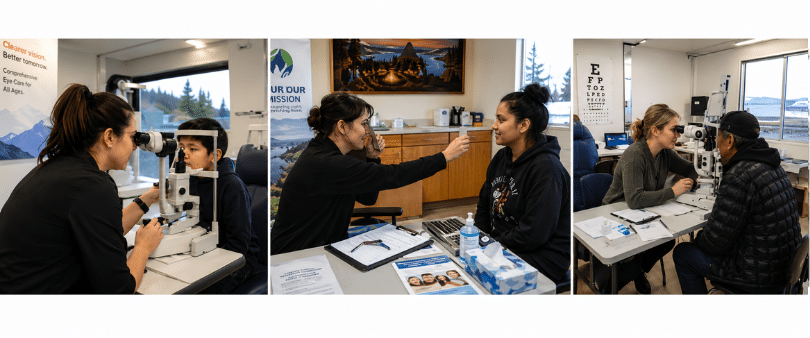
I don’t have the answers to all the questions that come up when practicing optometry outside of the clinic. I don’t think that anyone can completely satisfy all of these problems. But there are people out there working on them. My supervisor in BC was very excited about a new opportunity FYidoctors was going to provide him with, which was a travelling optometry clinic created from a bus. It was built with a full exam lane, virtual visual field system, and storage for a small dispensary, and would be able to travel to rural areas to provide eye care. This is just one example of  providers who are working to help the people in their particular community. And that inspires me to continue to try to find solutions, too. While these challenges persist, I remain committed to finding solutions and advocating for greater access to eye care, both in Canada and abroad. Every patient deserves the opportunity to see clearly, and I am determined to play my part in making that a reality.

Want to see more like this article? Click here to subscribe to our FREE print magazines and e-newsletters!


Zyloware Celebrates 101 Years of Excellence with New Growth Initiative Welcoming CenterGate Capital as Majority Partner

Zyloware breaking news 2024

Zyloware Eyewear announces that CenterGate Capital has acquired a majority stake in the 101-year-old business. This strategic partnership marks a pivotal moment in Zyloware’s history, setting the stage for transformative growth and innovation while honoring its enduring legacy. Continued Shyer family ownership preserves the company’s legacy and ensures its DNA carries forward into the future.

As a third-generation family business, Zyloware has established itself as a trusted name in eyewear, celebrated for quality, style, and exceptional service. Partnering with CenterGate Capital, a firm recognized for driving growth and operational excellence, will empower Zyloware to expand its market presence and offerings without compromising its core values.

Co-CEO Jamie Shyer remarked, “I am proud of our company’s century-long commitment to the optical industry. With a foundation of quality, creative design, and exceptional customer service, we look forward to continuing our legacy for many years to come.”

Founded in 1923, Zyloware has been a cornerstone of the optical community, providing expert support and serving generations of customers. This partnership with CenterGate combines Zyloware’s storied heritage with cutting-edge resources, positioning the company for sustained growth and success.

Co-CEO Christopher Shyer added, “This is a tremendous milestone for our company. Our partnership with CenterGate will enhance opportunities for our employees, customers, and business partners as we embark on this new exciting chapter.”

CenterGate Capital shares Zyloware’s dedication to its founding principles and will help fuel its evolution. The new partnership will support advancements in technology, product innovation, and market expansion, ensuring Zyloware remains a leader in the optical industry for decades to come.

“We are honored to partner with Zyloware and the Shyer family to build on their impressive legacy. We look forward to working together to drive growth and create new opportunities.”

Michael Smith, Managing Director, CenterGate Capital

Zyloware collaborated with Ernst & Young Capital Advisors to successfully facilitate its strategic partnership with CenterGate Capital.

Zyloware will continue to operate under its trusted name and retain its experienced team, ensuring a seamless transition for employees and customers as it moves confidently into the future.

Click HERE for the press release.

Want to see more like this article? Click here to subscribe to our FREE print magazines and e-newsletters!

OAC Reaffirms Commitment to Collaboration with Ontario Opticians Association

Opticians Association of Canada logo

The Opticians Association of Canada (OAC) wishes to clarify the status of its Collaboration Agreement with the Ontario Opticians Association (OOA). The OAC has not suspended the agreement, nor does it have any intention of doing so. Furthermore, the OAC has not received any formal notice of suspension from the OOA.

The OAC remains committed to working collaboratively with the OOA to serve the best interests of opticians in Ontario and across Canada. In the spirit of continued partnership, the OAC has requested a clarification meeting with the OOA on December 12 to discuss the current status of the agreement and any concerns the OOA may have.

The OAC values its strong relationship with the OOA and looks forward to a healthy discussion focused on solutions that benefit all opticians.

Related article:

An Important Message from the OOA

Click HERE for the press release.

Want to see more like this article? Click here to subscribe to our FREE print magazines and e-newsletters!

From Hair Combs to Eyewear

A selection of four hair combs and one pair of eyeglasses. The hair combs are made of a variety of materials, including bone, horn, and metal.

The Evolution of Artisanal Craftsmanship

By Sarah Bureau, RO

During the 18th century, hair combs were a staple accessory in women’s fashion, particularly among the European elite. These simple combs, made from bone, horn, and metal, were designed for practicality to support elaborate hairstyles. While they lacked the ornate stylings that would emerge in the 19th century, these early combs laid the foundation for artisanal skills that would later transition into the intricate craft of eyewear manufacturing.

Shifting Trends and Rising Popularity of Hair Combs

As fashion styles progressed from the subtle designs of the early 19th century (1800s – 1830s) into more ornate and elaborate trends in the mid-19th century (1840s -1860s) the styling of hair combs also shifted considerably. Women’s hairstyles became more voluminous and embellished, requiring hair accessories that both enhanced the aesthetic and offered structural support.

The hair combs of the mid-19th century were hand carved from materials such as tortoise shell, ivory, and horn and featured elaborate details such as floral motifs and intricate inlays. The use of luxury materials and the trend towards opulence was demonstrated by the styling of the hair combs created during this time. By the end of the 19th century (1870s-1900s), ornate hair combs reached the peak of their popularity, accessorizing the period’s complex hairdos and lavish clothing. Advances in technology allowed for even more detailed expressions in design, and at this time a new material, celluloid, was introduced in the production of hair combs. This new plastic could be created to mimic the appearance of natural materials such as horn and bone.

As the century turned (1900s-1930s), fashion trends shifted to the sleek, streamlined styles of the flapper era, with women wearing their hair short. This change, along with the move away from long, stylized hair, led to a significant decline in the popularity of hair combs.

Transferring Hair Comb Skills to Eyewear

As the popularity of hair combs declined, the industry that had thrived for 100 years faced a sudden downturn. However, the artisans, with their advanced technology and generational skills in hand carving comb materials, inlaying mother-of-pearl and metal, and hand polishing, found these techniques directly transferable to the art of making eyewear.

The high level of artistry, precision, and expertise in working with materials like bone, horn, and tortoise allowed these hair comb artisans to both enter and thrive in the eyewear market and is a perfect example of how traditional craftsmanship can evolve. The success these initial craftsmen had in transitioning their honed skills into frame making was an inspiration to fellow comb artisans who followed in their footsteps, diversifying and adapting to changing trends. This set a precedent for future generations of craftsmen and manufacturers and their legacy has continued to inspire modern frame makers.

From Hair Comb Making to Plastics Valley

The artisans in the town of Oyonnax, located in the Jura Mountains region of France, exemplify the transition from comb making to eyeglass manufacturing. Using their natural resources, this region was known for creating hair combs from wood and horn as early as the 18th century. As celluloid was introduced in 1860, the town of Oyonnax entered the world of plastics manufacturing, eventually becoming the hub of production for the new invention ‘acetate’ in the 1940s.

Lightweight, durable, flexible, and with a multitude of options for colour and design, this new plastic became the go-to material for eyeglass production, securing the town of Oyonnax as a prominent plastics manufacturing region that is often referred to as “Plastics Valley”. France’s largest acetate manufacturing producer Décoracet is located in Oyonnax. Décoracet originates from one of the oldest companies in Oyonnax, G. Convert SA, which has been producing plastics since its founding in 1830.

A Modern Hair Comb Legacy of Exquisite Craftsmanship

To this day, Oyonnax is a destination for eyeglass enthusiasts and many well-known eyeglass manufacturers hail from the Jura region of France, including Gouverneur Audigier, Julbo, and Morel which is the company behind brands like 1880, Koali, Öga, Lightec, and Nomad. While Oyonnax has become known mainly for its production of French eyewear, there are still some comb makers who thrive in the region, such as Veinière hair accessories which was founded by Elysée and Marie Veinière in 1892 and is to this day manufacturing and distributing hair accessories around the world. The production of combs and spectacles has made Oyonnax famous throughout the world and is now home to the “Museum of the Comb and the Plastics Industry”.

Close up of Julbo Loop eyeglass frames.
Julbo
Close up of Morel Cyan 3 GO07 eyeglass frames, in orange-grey.
Morel

The transition from making ornamental hair combs to creating eyeglasses represents a natural evolution driven by overlapping skills, shared materials, and changing market demands. The craftsmanship involved in creating both art types demonstrated the versatility of artisans, who capitalized on their existing expertise to embrace new opportunities in the burgeoning field of eyewear.


Sarah Bureau has been a licensed dispensing Optician in Niagara, Ontario for more than 20 years. She is the woman behind sbspecs, specializing in repairing and customizing eyewear for Opticians all across North America. Her love for restoring eyewear and modifying frames for unique fits is evident in the care she puts into each pair that crosses her workbench.

Sarah Bureau œuvre à titre d’opticienne autorisée à Niagara, en Ontario, depuis plus de 20 ans. Elle est propriétaire de sbspecs, une entreprise qui se spécialise dans la réparation et la personnalisation des lunettes pour les opticiens de partout en Amérique du Nord. Chaque paire de lunettes qui passe entre ses mains témoigne de son amour pour la restauration des lunettes et la modification des montures.

Contact Lens Institute Names 2024 Culture Award Honorees

contact lens institute

Four U.S. and Canadian eye care professionals have been named Contact Lens Institute (CLI) Culture Award winners, recognizing their impact on fostering contact lens cultures that enhance patient experiences and business success. The honorees regularly exhibit behaviors and actions reflected in CLI’s recent See Tomorrow reports, which are available for free download at https://www.contactlensinstitute.org/resources/see-tomorrow/.

“We congratulate the recipients, who represent a variety of practice sizes, geographies and points in their careers. Our 2024 winners are examples to their peers and the profession on how contact lens prescribing can improve the lives of patients and positively impact practice outcomes.”

Stan Rogaski, executive director, Contact Lens Institute

The 2024 Contact Lens Institute Culture Award honorees are:

  • Jennifer Liao, OD, FAAO, FSLS, New England College of Optometry (NECO) Center for Eye Care, Boston. Through her teaching and clinical responsibilities, Dr. Liao inspires students and staff alike to deliver an optimal contact lens experience during every patient encounter.
  • Chandler Mann, OD, Stone Oak Vision Source, San Antonio. Dr. Mann is a recent graduate and owner of a cold start, rapidly growing practice, and regularly implements new methods to champion contact lenses across a variety of patients in his community.
  • Wes McCann, OD, Central Optometry & Upper Richmond Optometry, London, Ontario, Canada. Dr. McCann owns nine optometric clinics staffed by 17 doctors across the Greater Toronto Area, and regularly speaks with colleagues and industry professionals to advance contact lens prescribing.
  • Jennifer L. Stewart, OD, Look New Canaan, New Canaan, Conn. An industry consultant who recently returned to clinical care by opening her own practice, Dr. Stewart is focused on improving patient lives through customized care and innovative technology.

All honorees are now featured on the CLI YouTube channel, with individual video interviews describing replicable initiatives and patient stories that contribute to their practices’ success with soft contact lenses. These can be viewed at youtube.com/@thecontactlensinstitute.

CLI’s See Tomorrow initiative explores perspectives and behaviors that can influence contact lens fitting and wear. Its latest, no-cost research report, “Disrupting the Dropout Dilemma: Practical Steps to Keep Patients in Contact Lenses,” indicates that higher contact lens retention rates are well within the reach of eye care practices, with corresponding long-term wear and widespread patient satisfaction.

 Click HERE for the full press release.

Want to see more like this article? Click here to subscribe to our FREE print magazines and e-newsletters!

Featured Posts

Canadian Association of Optometrists logo

CAO Appoints Joelle Walker as New CEO, Effective January 2026

The Canadian Association of Optometrists has appointed Joelle Walker as its new CEO, effective January 2026, succeeding François Couillard after more than 40 years of leadership.

Learn More
World Council of Optometry

ECPs Share How they Use the WCO Alcon Dry Eye Wheel in New Video

The World Council of Optometry and Alcon have released a new video featuring eye care professionals from around the world sharing how they use the Dry Eye Wheel to support dry eye diagnosis, education, and management.

Read more
Optik Voilàs November-December 2025- COS Silhouette SPX_Illusion_2978_5530

SPX Illusion 2025: Lightness Meets Bold Style

Silhouette unveils SPX Illusion 2025, featuring two new lightweight shapes— including a striking geometric design—offered in five trend-forward colors like Canary Green Havana and Smokey Blossom. A refined, featherlight way to express personal style with elegance.

Read more
EssilorLuxottica

EssilorLuxottica Expands Ophthalmology Footprint with Acquisition of Signifeye

EssilorLuxottica will acquire Signifeye, adding 15 Belgian clinics to its growing ophthalmology network and strengthening its integrated medical eye-care strategy.

Read more
Centre for Ocular Research & Education (CORE)

CORE Summarizes TFOS DEWS III Reports to Boost Dry Eye Knowledge

CORE has published issue 87 of Contact Lens Update, summarizing key findings from the TFOS DEWS III dry eye reports. Expert-authored content and downloadable PDFs provide clinicians with practical guidance on diagnosis, management, and evolving best practices.

Read more
Canadian Association of Optometrists logo

CAO Appoints Joelle Walker as New CEO, Effective January 2026

The Canadian Association of Optometrists has appointed Joelle Walker as its new CEO, effective January 2026, succeeding François Couillard after more than 40 years of leadership.

Learn More
World Council of Optometry

ECPs Share How they Use the WCO Alcon Dry Eye Wheel in New Video

The World Council of Optometry and Alcon have released a new video featuring eye care professionals from around the world sharing how they use the Dry Eye Wheel to support dry eye diagnosis, education, and management.

Read More
Optik Voilàs November-December 2025- COS Silhouette SPX_Illusion_2978_5530

SPX Illusion 2025: Lightness Meets Bold Style

Silhouette unveils SPX Illusion 2025, featuring two new lightweight shapes— including a striking geometric design—offered in five trend-forward colors like Canary Green Havana and Smokey Blossom. A refined, featherlight way to express personal style with elegance.

Read More
EssilorLuxottica

EssilorLuxottica Expands Ophthalmology Footprint with Acquisition of Signifeye

EssilorLuxottica will acquire Signifeye, adding 15 Belgian clinics to its growing ophthalmology network and strengthening its integrated medical eye-care strategy.

Read More
Centre for Ocular Research & Education (CORE)

CORE Summarizes TFOS DEWS III Reports to Boost Dry Eye Knowledge

CORE has published issue 87 of Contact Lens Update, summarizing key findings from the TFOS DEWS III dry eye reports. Expert-authored content and downloadable PDFs provide clinicians with practical guidance on diagnosis, management, and evolving best practices.

Read More
Canadian Association of Optometrists logo

CAO Appoints Joelle Walker as New CEO, Effective January 2026

The Canadian Association of Optometrists has appointed Joelle Walker as its new CEO, effective January 2026, succeeding François Couillard after more than 40 years of leadership.

Learn More
World Council of Optometry

ECPs Share How they Use the WCO Alcon Dry Eye Wheel in New Video

The World Council of Optometry and Alcon have released a new video featuring eye care professionals from around the world sharing how they use the Dry Eye Wheel to support dry eye diagnosis, education, and management.

Read more
Optik Voilàs November-December 2025- COS Silhouette SPX_Illusion_2978_5530

SPX Illusion 2025: Lightness Meets Bold Style

Silhouette unveils SPX Illusion 2025, featuring two new lightweight shapes— including a striking geometric design—offered in five trend-forward colors like Canary Green Havana and Smokey Blossom. A refined, featherlight way to express personal style with elegance.

Read more
EssilorLuxottica

EssilorLuxottica Expands Ophthalmology Footprint with Acquisition of Signifeye

EssilorLuxottica will acquire Signifeye, adding 15 Belgian clinics to its growing ophthalmology network and strengthening its integrated medical eye-care strategy.

Read more
Centre for Ocular Research & Education (CORE)

CORE Summarizes TFOS DEWS III Reports to Boost Dry Eye Knowledge

CORE has published issue 87 of Contact Lens Update, summarizing key findings from the TFOS DEWS III dry eye reports. Expert-authored content and downloadable PDFs provide clinicians with practical guidance on diagnosis, management, and evolving best practices.

Read more
Canadian Association of Optometrists logo

CAO Appoints Joelle Walker as New CEO, Effective January 2026

The Canadian Association of Optometrists has appointed Joelle Walker as its new CEO, effective January 2026, succeeding François Couillard after more than 40 years of leadership.

Learn More
World Council of Optometry

ECPs Share How they Use the WCO Alcon Dry Eye Wheel in New Video

The World Council of Optometry and Alcon have released a new video featuring eye care professionals from around the world sharing how they use the Dry Eye Wheel to support dry eye diagnosis, education, and management.

Read more
Optik Voilàs November-December 2025- COS Silhouette SPX_Illusion_2978_5530

SPX Illusion 2025: Lightness Meets Bold Style

Silhouette unveils SPX Illusion 2025, featuring two new lightweight shapes— including a striking geometric design—offered in five trend-forward colors like Canary Green Havana and Smokey Blossom. A refined, featherlight way to express personal style with elegance.

Read more
EssilorLuxottica

EssilorLuxottica Expands Ophthalmology Footprint with Acquisition of Signifeye

EssilorLuxottica will acquire Signifeye, adding 15 Belgian clinics to its growing ophthalmology network and strengthening its integrated medical eye-care strategy.

Read more
Centre for Ocular Research & Education (CORE)

CORE Summarizes TFOS DEWS III Reports to Boost Dry Eye Knowledge

CORE has published issue 87 of Contact Lens Update, summarizing key findings from the TFOS DEWS III dry eye reports. Expert-authored content and downloadable PDFs provide clinicians with practical guidance on diagnosis, management, and evolving best practices.

Read more