
fbpx
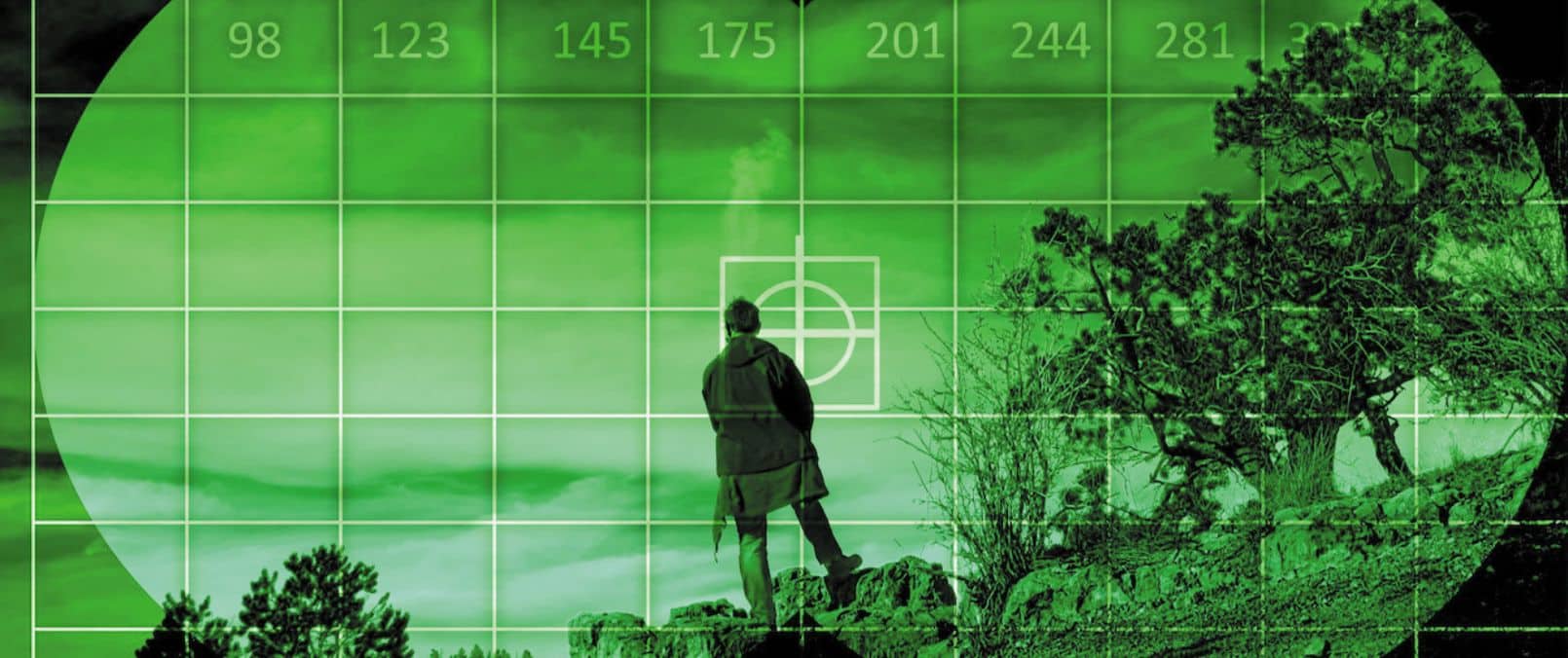
Night vision technology view through a night vision device, showing a person standing on rocky terrain with trees in the background. The image is green-tinted with a grid overlay, typical of night vision imagery.

ABCs of Optics: N is for Night Vision (part 3 of 3)

This course is accredited for 1 EC for NACOR and 1 CL/EG/RF for COO.
NACOR #110.643 and COO #4250
Completion of online post-course test required at www.OptikConEd.com.


By Thomas Weissberger, RO

Tech for Night Vision: Seeing in the Dark

Night vision technology is a fascinating invention that allows us to see in the dark. It has been developed for military use, but now it is also used in various other fields. There are several techniques for night vision, including low-light imaging, thermal imaging, and illumination. Night vision devices (NVDs) are constructed from three main blocks: optical objective, picture intensifier tube, and ocular eyepiece. The optical objective creates a low intensity, invisible image of the observed scenery at the picture intensifier tube’s input line. The latter tube consisting of a photo cathode, a phosphor screen anode, and other elements intensifies an input low luminance image into a brighter anode image.

NVD’s can be broken down into three main types:

Image intensifier night vision: This type of night vision amplifies available light to produce an image. It works by collecting and amplifying ambient light, such as moonlight or starlight, and then projecting it onto a phosphor screen that glows green. Image intensifier night vision is the most common type of night vision device and is used in a variety of applications, including military, law enforcement, and surveillance.

Digital night vision devices: Digital night vision devices use digital technology to amplify available light and produce an image. They work by collecting available light through an objective lens and then processing the image through a digital image sensor. The image is then displayed on a screen, which can be either a built-in screen or an external monitor. Digital night vision devices are typically smaller and lighter than image intensifier night vision devices and are used in a variety of applications, including hunting, wildlife observation, and surveillance.

Thermal imagers: Thermal imagers use thermal radiation to produce an image. They work by detecting the heat emitted by objects and then producing an image based on the temperature differences between objects. Thermal imagers are used in a variety of applications, including military, law enforcement, and surveillance.

Night Vision Technology: Infrared and Near Infrared Systems:

Infrared vision is the capability of biological or artificial systems to detect infrared radiation. The terms thermal vision and thermal imaging are also commonly used in this context since infrared emissions from a body are directly related to their temperature: hotter objects emit more energy in the infrared spectrum than colder ones. Infrared vision is used in various fields, including military, surveillance, and wildlife observation. It is also used in medical imaging, where it can detect inflammation and other abnormalities.

The infrared system has been shown to be superior to the near-infrared system. Near-infrared images have been identified as having substantially higher visual clutter compared to far-reaching infrared images. Visual clutter is the abundance of items, colours, textures, and patterns in a space that can lead to sensory overload; visual clutter can also affect information visualization, where it can obscure the structure and patterns present in the data, thus images seen in devices used for infrared or near-infrared can often be blurred or indistinct, especially in more basic equipment that does not use enhancement programs to define an object.

Far-Infrared Imaging

Far-infrared images are thought to be more peculiar and hence more difficult to view, although the presence of the image is presumably related to the lower visual clutter. Also, bright, shorter wavelength light can affect the quality of the images generated. Night vision technology is a remarkable invention that has revolutionized the way we see in the dark. The technology is still evolving, and more advanced and sophisticated night vision devices are expected in the future.

In conclusion, the term night vision encapsulates both our ability to adapt to and see in the dark, and the devices available today to enhance low-light vision. Although these devices today are used mainly for task specific reasons, technology is advancing at a pace that will make these devices much more useful in the near future for general use and overall visual enhancement for those with visual needs.


Want to see more like this article? Subscribe to our FREE print magazines and e-newsletters!


Illustration of Thomas Weissberger, RO, wearing a graduation cap and blue glasses, labeled 'The Practical Professor: Optical Solutions for the Real World.'

The Practical Professor: Optical Solutions for the Real World

I am a second generation optician and have made all aspects of opticianry and optics my life. I have over 10 years of teaching experience as a former professor in the Dispensing Opticians’ program at Seneca College and at Georgian College. I was also responsible for
modernization of the optical curriculum.

I am a trainer and trainee (One never stops learning!), and I am available to share my knowledge and experience with today’s eye care professionals. As the owner of Special Eyes Optical Services, I am dedicated to supporting the optical industry. You can reach out to me at Tom@SpecialeyesOpticalServices.com.


Featured Posts

EssilorLuxottica

EssilorLuxottica Creates Scientific Advisory Committee to Cccelerate Next Era of Innovation

EssilorLuxottica forms a new Scientific Advisory Committee of global experts to guide innovation in ophthalmology, AI, audiology, and life sciences.

Learn More
MIDO logo

MIDO 2026 Exhibitor List Now Live as “The Lens of Time” Exhibition Debuts

MIDO 2026 unveils its exhibitor list and debuts “The Lens of Time,” with 1,200 exhibitors, new installations, and expanded event programming.

Read more
World Council of Optometry

WCO Announces 2025 Election Results and New Global Leadership

The World Council of Optometry announces its 2025 election results and new leadership appointments, shaping the next phase of global optometric advocacy.

Read more
University Waterloo School of Optometry

WEI 2025: Education, Innovation, and Connection

The WEI Conference returns November 7–9, 2025 at the Hilton Toronto/Markham Suites with over 20 hours of COPE-accredited CE, the Woodruff and Bobier Distinguished Lectures, a strong speaker lineup, and a trade show featuring 30+ exhibitors — including VuePoint IDS at Booth #311.

Read more
Eye On the Industry podcast EOTI

Eye on the Industry Podcast Episode 6: Practice Growth Made Simple with Dr. Kiran Ramesh

Dr. Kiran Ramesh joins Eye on the Industry to share how systems, teams, and CEO mindset drive practice growth. Practical insights for independent eye care professionals.

Read more
EssilorLuxottica

EssilorLuxottica Creates Scientific Advisory Committee to Cccelerate Next Era of Innovation

EssilorLuxottica forms a new Scientific Advisory Committee of global experts to guide innovation in ophthalmology, AI, audiology, and life sciences.

Learn More
MIDO logo

MIDO 2026 Exhibitor List Now Live as “The Lens of Time” Exhibition Debuts

MIDO 2026 unveils its exhibitor list and debuts “The Lens of Time,” with 1,200 exhibitors, new installations, and expanded event programming.

Read More
World Council of Optometry

WCO Announces 2025 Election Results and New Global Leadership

The World Council of Optometry announces its 2025 election results and new leadership appointments, shaping the next phase of global optometric advocacy.

Read More
University Waterloo School of Optometry

WEI 2025: Education, Innovation, and Connection

The WEI Conference returns November 7–9, 2025 at the Hilton Toronto/Markham Suites with over 20 hours of COPE-accredited CE, the Woodruff and Bobier Distinguished Lectures, a strong speaker lineup, and a trade show featuring 30+ exhibitors — including VuePoint IDS at Booth #311.

Read More
Eye On the Industry podcast EOTI

Eye on the Industry Podcast Episode 6: Practice Growth Made Simple with Dr. Kiran Ramesh

Dr. Kiran Ramesh joins Eye on the Industry to share how systems, teams, and CEO mindset drive practice growth. Practical insights for independent eye care professionals.

Read More
EssilorLuxottica

EssilorLuxottica Creates Scientific Advisory Committee to Cccelerate Next Era of Innovation

EssilorLuxottica forms a new Scientific Advisory Committee of global experts to guide innovation in ophthalmology, AI, audiology, and life sciences.

Learn More
MIDO logo

MIDO 2026 Exhibitor List Now Live as “The Lens of Time” Exhibition Debuts

MIDO 2026 unveils its exhibitor list and debuts “The Lens of Time,” with 1,200 exhibitors, new installations, and expanded event programming.

Read more
World Council of Optometry

WCO Announces 2025 Election Results and New Global Leadership

The World Council of Optometry announces its 2025 election results and new leadership appointments, shaping the next phase of global optometric advocacy.

Read more
University Waterloo School of Optometry

WEI 2025: Education, Innovation, and Connection

The WEI Conference returns November 7–9, 2025 at the Hilton Toronto/Markham Suites with over 20 hours of COPE-accredited CE, the Woodruff and Bobier Distinguished Lectures, a strong speaker lineup, and a trade show featuring 30+ exhibitors — including VuePoint IDS at Booth #311.

Read more
Eye On the Industry podcast EOTI

Eye on the Industry Podcast Episode 6: Practice Growth Made Simple with Dr. Kiran Ramesh

Dr. Kiran Ramesh joins Eye on the Industry to share how systems, teams, and CEO mindset drive practice growth. Practical insights for independent eye care professionals.

Read more
EssilorLuxottica

EssilorLuxottica Creates Scientific Advisory Committee to Cccelerate Next Era of Innovation

EssilorLuxottica forms a new Scientific Advisory Committee of global experts to guide innovation in ophthalmology, AI, audiology, and life sciences.

Learn More
MIDO logo

MIDO 2026 Exhibitor List Now Live as “The Lens of Time” Exhibition Debuts

MIDO 2026 unveils its exhibitor list and debuts “The Lens of Time,” with 1,200 exhibitors, new installations, and expanded event programming.

Read more
World Council of Optometry

WCO Announces 2025 Election Results and New Global Leadership

The World Council of Optometry announces its 2025 election results and new leadership appointments, shaping the next phase of global optometric advocacy.

Read more
University Waterloo School of Optometry

WEI 2025: Education, Innovation, and Connection

The WEI Conference returns November 7–9, 2025 at the Hilton Toronto/Markham Suites with over 20 hours of COPE-accredited CE, the Woodruff and Bobier Distinguished Lectures, a strong speaker lineup, and a trade show featuring 30+ exhibitors — including VuePoint IDS at Booth #311.

Read more
Eye On the Industry podcast EOTI

Eye on the Industry Podcast Episode 6: Practice Growth Made Simple with Dr. Kiran Ramesh

Dr. Kiran Ramesh joins Eye on the Industry to share how systems, teams, and CEO mindset drive practice growth. Practical insights for independent eye care professionals.

Read more