

Myopia Management 2.0:What’s Next?
Tuesday, July 14 2026 | 08 h 45 min | Optik Magazine, Practice Management
By Dr. Sheila Morrison, OD, MS, FAAO, FSLS, FCCSO
Over the last decade, myopia management has advanced significantly across academic institutions, optometry schools, and industry, helping shift the conversation from simple refractive correction toward active intervention. Spectacle lenses, soft contact lenses, orthokeratology, and pharmacologic approaches have all contributed to that progress, and the evidence base supporting myopia control is stronger than ever.
Yet despite these gains, an important gap remains: myopia management is still not consistently embedded as standard of care in everyday clinical practice. The field has made substantial progress in knowledge, innovation, and professional awareness, but broader adoption of even basic myopia control remains one of the profession’s most pressing unfinished tasks.
Beyond Defocus
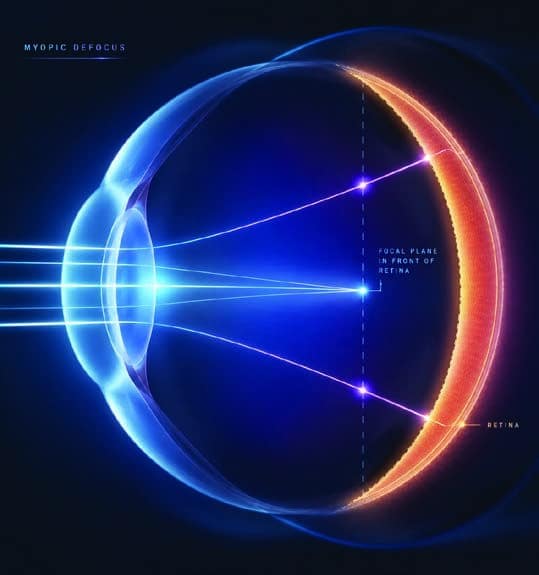
At the same time, the conversation within the field is moving beyond first-generation thinking. The modern question is not whether we can slow myopia progression, but how we can understand, refine, and optimize that effect more intelligently. In particular, the long dominant language of defocus may no longer be sufficient on its own to explain where the field is heading next.
Defocus remains an essential part of the story, but it increasingly appears to be only one component of a more complex visual and biological signaling system. Across both spectacle and contact lens development, growing attention is being paid to the possibility that aberration, contrast sensitivity, spatial frequency content, accommodative behaviour, and choroidal response may all play meaningful roles in regulating eye growth.
That is a significant conceptual shift. It suggests that the next frontier is not just lens design in the narrow optical sense, but a more refined form of retinal image quality engineering. Orthokeratology offers an example. Although often discussed through the framework of peripheral myopic defocus, its effects are unlikely to be explained by defocus alone. It also induces changes in higher-order aberrations, including spherical aberration, and may alter retinal image quality in ways that influence growth-regulating pathways. The same may be true, to varying degrees, for newer spectacle and soft contact lens designs, which do more than simply reposition focal planes. They also reshape local blur structure, contrast distribution, and the character of the visual stimulus across the retina.
Engineering the Retinal Image
Contrast sensitivity may allow us to understand light in the retina in new ways. The retina does not merely register whether light is in or out of focus; it responds to the strength, quality, and pattern of the image signal it receives. If contrast modulation and spatial frequency processing are shown to be more central to myopia control than previously appreciated, this could expand the design logic of future treatments. The aim would shift from correcting refractive error while adding a therapeutic defocus component, toward tailoring the overall retinal image environment in a more biologically informed way.
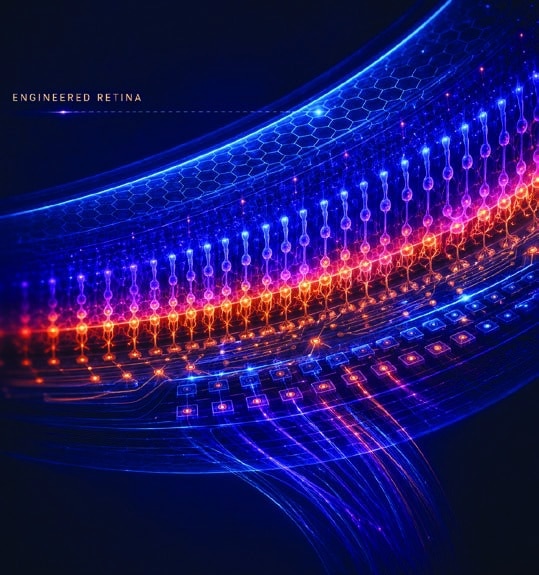
Such a shift may also help explain one of the field’s most persistent realities: not all children respond equally well to the same treatment. That is why the future is likely to involve not only better products, but more individualized treatment optimization. In time, treatment selection may depend less on broad categories alone. Spectacle lens, soft lens, orthokeratology, and atropine candidacy may be determined with streamlined or automated processes looking at a child’s specific optical, behavioural, and biometric profile. Baseline aberrations, pupil size, accommodative behaviour, contrast response, binocular status, peripheral optics, and axial growth pattern may all eventually inform more personalized decisions.
The Choroid as a Biological Bridge
Alongside these optical questions, the choroid has emerged as one of the most intriguing biological structures in current myopia research. Increasing evidence suggests that it may act as a dynamic intermediary between visual input and axial growth. Short-term choroidal thickening has been associated with myopia-inhibiting signals, while thinning appears linked to conditions that promote elongation. The choroid is not yet a routine clinical marker, but it may prove to be one of the most important bridges between mechanism and management.
Its relevance extends well beyond lenses. If choroidal behaviour forms part of the eye-growth signaling pathway, then it becomes easier to understand how light exposure, medications, and other less traditional interventions might influence the same system through different entry points. This is one reason the future of myopia management may become less siloed. Optical, pharmacologic, and environmental approaches may increasingly be understood not as competing philosophies, but as complementary strategies acting on interconnected mechanisms.

That broader view also strengthens the case for greater attention to pre-myopia. Once a child becomes myopic, some degree of accelerated growth may already be underway. The next phase of care may therefore focus more heavily on identifying children at risk before refractive onset, using age, refractive status, family history, axial length patterns, and, eventually, more refined biomarkers. The goal would not simply be to slow established progression, but to delay or even prevent onset where possible.
Lifestyle, Light and the Visual Environment
This is where lifestyle and everyday visual environment deserve a more central place in the conversation. Research remains limited in several areas that are highly relevant to modern family life, but limited evidence should not be mistaken for lack of importance. Parents increasingly ask about nutrition, light exposure, prolonged near work, school intensity, screen use, study habits, sleep, and general wellbeing. These are not fringe concerns. They reflect the real-world conditions in which myopia develops.

Of these, light exposure remains a compelling and clinically actionable factor. Time outdoors is consistently associated with reduced myopia onset, and its effects may involve dopamine signaling, retinal adaptation, and choroidal response. That alone should secure its place as a mainstream part of myopia counselling. But the conversation should not stop there. The modern child often spends long hours in sustained near work under highly demanding visual conditions, with short viewing distances, limited task breaks, and heavy digital device use. Even where evidence remains incomplete, school and studying ergonomics should become more routine topics in clinical practice: working distance, posture, regular breaks, print size, screen position, and the balance between near work and time outdoors.
Nutrition is more speculative, but still worth acknowledging in a balanced way. There is currently insufficient evidence to support specific nutritional prescriptions for myopia control, and the field should resist overstating what is not yet known. At the same time, it is increasingly difficult to maintain a model of ocular development that is entirely detached from systemic health. A balanced diet, healthy sleep, physical activity, and overall wellness may not yet be measurable as direct axial-length therapies, but they belong within a preventive framework of care.
Toward a Whole-Child Model of Care
That may be the deeper opportunity now facing the profession. Myopia management can evolve from a treatment conversation into a whole-child health conversation. Spectacle and contact lens innovation will remain central, and rightly so. But the next frontier may be defined just as much by integration as by invention: integrating optical mechanisms with biology, integrating treatment with prevention, and integrating lens-based care with the broader realities of children’s health and daily lives.
If the first era of myopia management proved that progression can be slowed, the next era may be about something more ambitious: understanding why children respond differently, refining treatment with greater precision, and bringing prevention, lifestyle, and wellbeing closer to the centre of care. That is what Myopia Management 2.0 may ultimately mean, not simply more intervention, but better understanding which translates to more sophisticated clinical decision making.
About the Author:

Dr. Sheila Morrison, OD, MS, FAAO, FSLS, FCCSO
Dr. Sheila Morrison is an Alberta-based optometrist, educator, and clinical researcher specializing in cornea, contact lenses, myopia management, and dry eye. A former clinical university professor, she practices at Mission Eye Care in Calgary, Alberta, and supervises an accredited cornea and contact lens residency. She lectures, publishes internationally, and collaborates in clinical research.
Want to see more articles like this? Click here to subscribe to our FREE print magazine and newsletters!