

University of Waterloo Platform Produces 3D-Printed Contact Lenses in 20 Minutes
Tuesday, July 14 2026 | 11 h 40 min | News, Vision Science
Researchers at the University of Waterloo have developed a 3D-printing platform capable of producing patient-specific contact lenses in as little as 20 minutes.
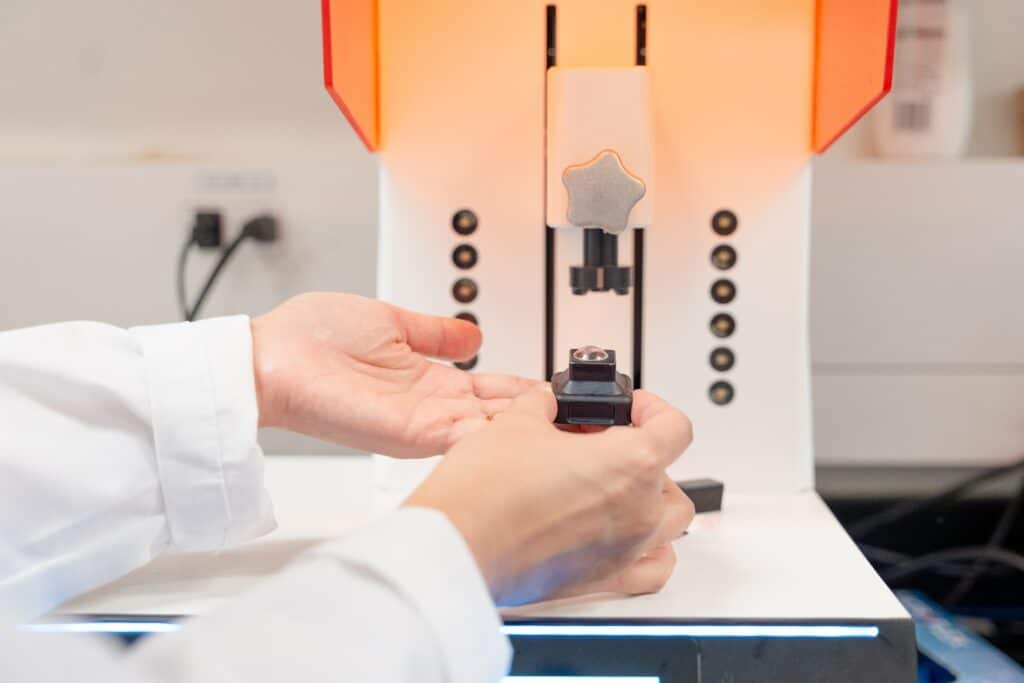
The technology combines custom lens-design software, a new hydrophilic silicone formulation and a non-contact surface-finishing process. The researchers say the platform could eventually support the design, manufacture and dispensing of specialized contact lenses during a single visit to an optometrist.
A Potentially Faster Route to Customized Lenses
The platform is intended to address some of the time and complexity associated with fitting patients whose corneal profiles fall outside the parameters accommodated by standard lens designs.
For patients requiring highly customized rigid lenses, the fitting process may involve multiple diagnostic lenses, modifications and follow-up visits before an acceptable combination of fit, vision and comfort is achieved.
The Waterloo platform uses digital design and additive manufacturing to produce a lens with an inner surface matched to the patient’s corneal profile and an outer surface designed to provide the required refractive correction.
“We are very excited about this work because it brings us closer to contact lenses that are truly personalized,” said Dr. Shirley Tang, professor in Waterloo’s Department of Chemistry. “Our technology produces lenses with patient-specific surfaces for a precise fit while delivering the optical clarity and mechanical performance expected of commercial contact lenses.”
New Silicone Formulation Designed for 3D Printing
A central component of the platform is a hydrophilic silicone material developed specifically for vat photopolymerization printing.
While silicone materials offer the oxygen permeability and biocompatibility required for contact lens applications, conventional formulations are generally not suitable for additive manufacturing. The Waterloo team developed a new formulation intended to retain the necessary material properties while remaining compatible with the printing process.
“Our software designs a lens with an inner surface that precisely matches the patient’s cornea and an outer surface that provides the required vision correction,” said Dr. Sayan Ganguly, a research associate in Waterloo’s Department of Chemistry.
“The novel hydrophilic silicone material we created, combined with our manufacturing process, produces smooth, transparent lenses that are comfortable to wear.”
Surface-Finishing Process Improves Optical Quality
Layer-by-layer printing can create microscopic surface irregularities that may affect optical performance and lens comfort.
To address this issue, the researchers developed an ultra-thin, non-contact fluidization coating process designed to smooth the lens surface without altering its customized geometry or compromising its optical properties.
The complete platform integrates lens design, material development, printing and surface finishing into a digital manufacturing workflow.
Clinical Testing and Commercialization Still Ahead
Laboratory testing confirmed the biocompatibility of the printed lenses, and the research team is preparing for in vivo studies.
The technology therefore remains at the development stage and is not yet available for clinical use.
The researchers have filed a provisional patent for the hydrophilic silicone material and are preparing a full patent application.
The project is being advanced toward potential commercialization in collaboration with the Centre for Vision and Eye Research, a joint research institute of the University of Waterloo and Hong Kong Polytechnic University.
The platform received a Gold Medal at the Shanghai International Exhibition of Inventions in June 2026.
The study, “Patient-specific hard contact lenses fabricated by vat photopolymerization printing and non-contact fluidization coating,” was published in Materials & Design.
Source: University of Waterloo
Want to see more like this article? Click here to subscribe to our FREE print magazines and e-newsletters!