Based on: Ophthalmology Science, 2025 – Deep Learning Study
At a Glance
Population: OCT and fundus image datasets, thousands of eyes
Technology: Deep learning models applied to OCT vs. disc photos
Key outcome: Accuracy in detecting visual field–defined glaucoma
Summary
Australian researchers tested deep learning models trained on OCT versus traditional disc photographs to detect visual field–defined glaucoma. OCT-based AI models significantly outperformed disc-photo models, reinforcing the value of structural data for early disease detection.
While not ready for clinical rollout, the findings point to a future where OCT integrated with AI could assist with triage, referrals, and missed diagnoses. For eye care professionals, the study highlights OCT’s central role in glaucoma management, and the potential of AI to support, not replace, clinical expertise.
Practice Considerations
OCT continues to prove its value as the structural foundation in glaucoma care.
AI-assisted screening tools may soon enhance triage, referrals, and early detection.
Models still require validation across devices and patient populations before adoption.
Human expertise remains central—AI serves as augmentation, not replacement.
Low vision is more than a clinical definition. It is the loss of independence, the frustration of daily tasks, and the fear of a world no longer in focus.
The World Health Organization defines low vision as visual acuity between 20/70 and 20/400 with the best possible correction, or a visual field of 20 degrees or less.
The Mayo Clinic adds, “Low vision means having impaired vision that cannot be corrected by glasses, surgery or medication.”
We’ve heard these definitions before, but what do they actually look like in the lives of our clients?
Betty’s Struggle: When “Nothing More Can Be Done”
Imagine a client named Betty. She has just left her ophthalmologist’s office. Her vision is poor, she knows it will worsen, and she has been told there is nothing more that can be done. At home, her daughter is frustrated. Betty can spot an object on the floor 10 feet away yet says she cannot see her daughter even when looking straight at her. Betty’s new glasses from her optician didn’t solve her vision problems as she had hoped.
After losing her driver’s license and hearing her doctor say, “That’s it,” Betty feels isolated, angry, and afraid. Support services exist, but they are often hard to find. Searching online can be overwhelming and unreliable. Outside of major cities, in-person services are scarce. For many clients, a one-hour appointment means a full day of effort to arrange transportation, travel hours each way, endure physical strain, and face the added costs.
Opticians Can Change the Story
Opticians are uniquely positioned to make a difference. You can help clients understand their vision loss, introduce tools that maximize their remaining sight, and restore a sense of independence and safety. By offering low vision care, you become more than a provider; you become a lifeline.
Four Keys to Building a Low Vision Service
1. Keep learning. Deepen your knowledge of eye diseases like glaucoma, age-related macular degeneration, diabetic retinopathy, and cataracts. This will help you recommend the right aids and explain conditions in clear, compassionate language. Training is available through Eschenbach Academy,Georgian College, Seneca Polytechnic, and La Cité. For patients seeking self-directed learning and support, Hadley.org offers free online resources designed specifically for people living with vision loss.
2. Equip your practice. Clients need to handle and test low vision aids to see what truly works for them. Demonstrating proper use is essential to success. Top suppliers include Optelec, Eschenbach, and Humanware.
3. Reach your community. Ophthalmologists are valuable referral partners, but you need to be prepared and professional. Start conversations with clients who already show signs of vision loss. Connect with seniors’ groups, Lions and Probus clubs, nursing homes, and community fairs. These are all gateways to serving those who need you most.
4. Make time count. A low vision consultation often takes 60 to 90 minutes. Consider using quieter moments in your practice to serve one client instead of routine tasks. Delegating duties like cleaning frees up your time for meaningful care, which can build revenue and lasting trust.
Slow Down to Move Forward
In today’s fast-paced optical world, success is measured in income, time, and service. By slowing down and dedicating energy to low vision care, you’ll find the financial, professional, and personal rewards far outweigh the effort.
About the Author:
Krista Woods, RO
Krista Woods, RO, graduated with honors from Georgian College and has been a Registered Optician since 1995. She served as a NACOR Examiner from 2017 to 2024 and is an active member of the Opticians Association of Canada, the Ontario Opticians Association, the Worshipful Company of Spectacle Makers, and the International Opticians Association. In 2023, Krista’s low vision initiatives were featured in Helen Whittaker’s presentation at SILMO Singapore. Since 2017, Krista has specialized in low vision care, first through her own company, Krista Valerie Woods, and since 2022 with A Vision Above. In 2024, she began teaching Binocular Vision and Low Vision at Seneca Polytechnic.
Want to see more articles like this? Click here to subscribe to our FREE print magazine and newsletters!
Vision Expo, produced by RX and The Vision Council, in collaboration with VSP Vision™, a leader in health-focused vision care, announce the four startups selected to participate in the 2026 VSP Vision Innovation Challenge. The contest is a global competition designed to source, spur, and advance early-stage startups and technologies that are elevating the eye care experience.
The four finalists will participate in a four-week startup bootcamp in February 2026, receiving expert mentorship and exclusive resources to refine their value propositions. They will present their solutions live on stage at Vision Expo inside the Orange County Convention Center in Orlando, Florida on March 13, 2026, and showcase their products on the show floor as part of the Innovation Center, an area designated for industry startups.
“The VSP Vision Innovation Challenge underscores our belief that bold, future-ready concepts are essential to advancing eyecare,” said Ashley Mills, CEO of The Vision Council. “Innovation Center at Vision Expo expands that mission by elevating startups and the technologies redefining what’s possible. The Show’s programming is designed for attendees to discover new ideas, and we’re proud to champion the innovators pushing the field ahead.”
“We received applications from companies around the globe for the 2026 VSP Innovation Challenge, with more than half being venture-backed and collectively representing over $300 million in funding,” said Will Flanagan, Head of VSP Global Innovation Center Programs and Partnerships. “These founders are committed to enhancing provider and patient experiences and empowering private practices to thrive, and we’re excited to help accelerate their progress.”
In addition to the exposure at one of the largest gatherings of vision care executives and professionals, selected early-stage startups will have the potential to secure a $400,000 investment from Topcon Healthcare, Inc.’s THINC Ventures capital arm.
Innovation Stage, Vision Expo Friday, March 13, 2026 10:30am – 11:30am ET
Meet the 2026 Finalists
Altris AI: Clinical-grade SaaS platform serves as a “second set of eyes” for eye care specialists, identifying 70+ retinal biomarkers from OCT scans to help providers match patients to appropriate treatments, devices, and clinical trials with objective, data-driven precision.
Alchemy Vision: Modern, subscription-based digital training platform designed for today’s eye care environment.
EyeCareX: OD-founded AI platform using computer vision and generative AI to automate and standardize core components of the optometric exam, enabling clinics and enterprise networks to increase patient capacity and deliver more consistent care.
Captify: Builds prescription-ready, AI-enabled smart eyewear that provides real-time captioning for patients with hearing loss, empowering independent optometrists to deliver cutting-edge accessibility tools that enhance patient quality of life.
A street, a moment, a glance. LIFE captures these fragments of everyday life where everything unfolds naturally: a phone call, a smile, a spontaneous gesture. Simple, vibrant urban scenes where personality emerges effortlessly.
In these candid moments, the glasses become a natural choice. They complement the look, accentuate character, and express a way of being. Far more than an accessory, they stand as a marker of identity, revealing what each person chooses to show the world.
Through this series of portraits of men and women, LIFE celebrates a free and sincere expression of style, energized by real life. From the iconic series SLEDGE to the new metal frames for women, it perfectly reflects the DNA of J.F. Rey: a free, bold, and colorful design, revealing each person’s personality, at any age.
Want to see more like this article? Click here to subscribe to our FREE print magazines and e-newsletters!
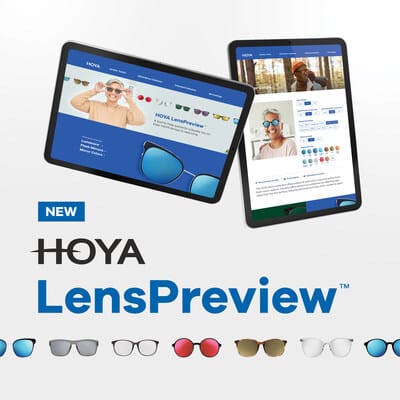
HOYA Vision Care has announced the launch of HOYA LensPreview™, a new virtual try-on tool designed to help eye care professionals (ECPs) and patients visualize specialty lenses before purchase. The solution is now available in the United States and Canada and is integrated into the company’s HOYA Hub™ digital platform.
According to HOYA, LensPreview allows users to preview a range of lens options, including photochromic, polarized, and mirror lenses, in a true-to-colour, interactive environment. Supported product families include the Sensity® range, HOYA’s Mirror Collection, Lumacore™, and polarized lenses. The company says the tool is intended to reduce reliance on physical lens samples while helping patients better understand how different lens options will appear in real-world use.
“This tool enhances the patient experience and helps practices boost second pair and sun lens sales while eliminating the need for physical samples,” said Samy Lauriette, Vice President of Strategic Marketing, North America at HOYA Vision Care, in a company statement.
HOYA notes that LensPreview addresses several operational and clinical challenges faced by practices, including managing patient expectations, simplifying in-office workflows, and supporting conversations around premium lens options. By offering a digital alternative to demo lenses, practices may also reduce costs associated with shipping, storage, and inventory management.
The virtual try-on technology is powered by Fittingbox, a provider of digital eyewear visualization solutions. According to Fittingbox, the integration delivers an immersive lens simulation experience directly within the HOYA Hub ecosystem.
HOYA LensPreview is currently available at no additional cost to HOYA customers who have access to the HOYA Hub via single sign-on. The HOYA Hub platform also provides tools for job tracking, invoicing, payments, shipping label printing, and access to marketing and social media resources. Eye care professionals who are not currently using the HOYA Hub are encouraged to contact their local HOYA business consultant for access.
View a video demonstration of HOYA LensPreview in action here.
Episode 10 of Eye on the Industry features Dr. Harbir Sian on scope modernization, social media, myopia management, clinic culture, and the future of optometry in Canada.
EssilorLuxottica has acquired a stake in Top Charoen, Thailand’s largest retail optical chain, reinforcing its long-standing relationship with the company and its presence in Southeast Asia.
By any measure, contact lenses remain a cornerstone of modern vision correction. Yet despite ongoing innovation and a steadily expanding global market, the overall number of contact lens wearers has not grown at the same pace as the technology.
Episode 10 of Eye on the Industry features Dr. Harbir Sian on scope modernization, social media, myopia management, clinic culture, and the future of optometry in Canada.
EssilorLuxottica has acquired a stake in Top Charoen, Thailand’s largest retail optical chain, reinforcing its long-standing relationship with the company and its presence in Southeast Asia.
By any measure, contact lenses remain a cornerstone of modern vision correction. Yet despite ongoing innovation and a steadily expanding global market, the overall number of contact lens wearers has not grown at the same pace as the technology.
Episode 10 of Eye on the Industry features Dr. Harbir Sian on scope modernization, social media, myopia management, clinic culture, and the future of optometry in Canada.
EssilorLuxottica has acquired a stake in Top Charoen, Thailand’s largest retail optical chain, reinforcing its long-standing relationship with the company and its presence in Southeast Asia.
By any measure, contact lenses remain a cornerstone of modern vision correction. Yet despite ongoing innovation and a steadily expanding global market, the overall number of contact lens wearers has not grown at the same pace as the technology.
Episode 10 of Eye on the Industry features Dr. Harbir Sian on scope modernization, social media, myopia management, clinic culture, and the future of optometry in Canada.
EssilorLuxottica has acquired a stake in Top Charoen, Thailand’s largest retail optical chain, reinforcing its long-standing relationship with the company and its presence in Southeast Asia.
By any measure, contact lenses remain a cornerstone of modern vision correction. Yet despite ongoing innovation and a steadily expanding global market, the overall number of contact lens wearers has not grown at the same pace as the technology.