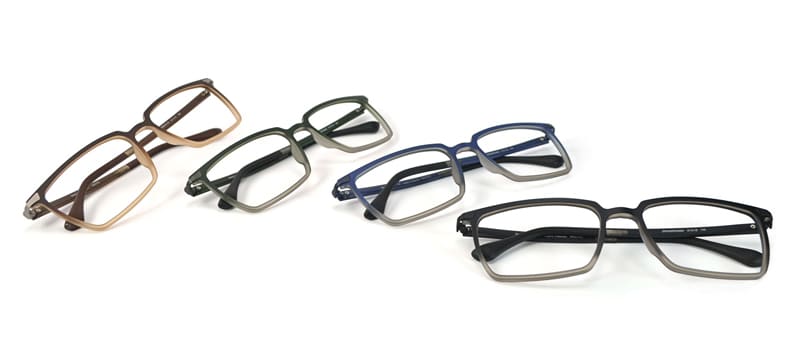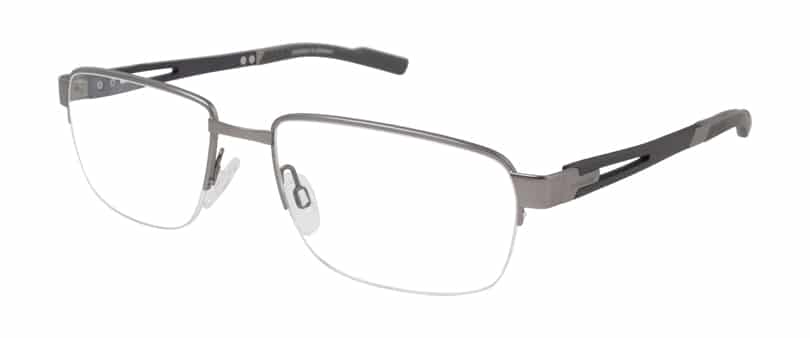
Luxottica has revamped two iconic models from the Persol line, in sunglass and ophthalmic versions. Created in 1963 and worn by Steve McQueen in the film The Thomas Crown Affair, model 649 was the first frame that could be folded in four to fit into the breast pocket of a suit jacket. Luxottica has revisited the classic model (PO714) and a modern evolution of the model (PO714S). The Italian eyewear manufacturer has also redesigned the Cellor model (PO3105S), which gets its name from the materials used to make it (celluloid and gold). The PO9714VM and PO3105VM models are both ophthalmic versions. www.luxottica.com
Claire Goldsmith introduces eight new models
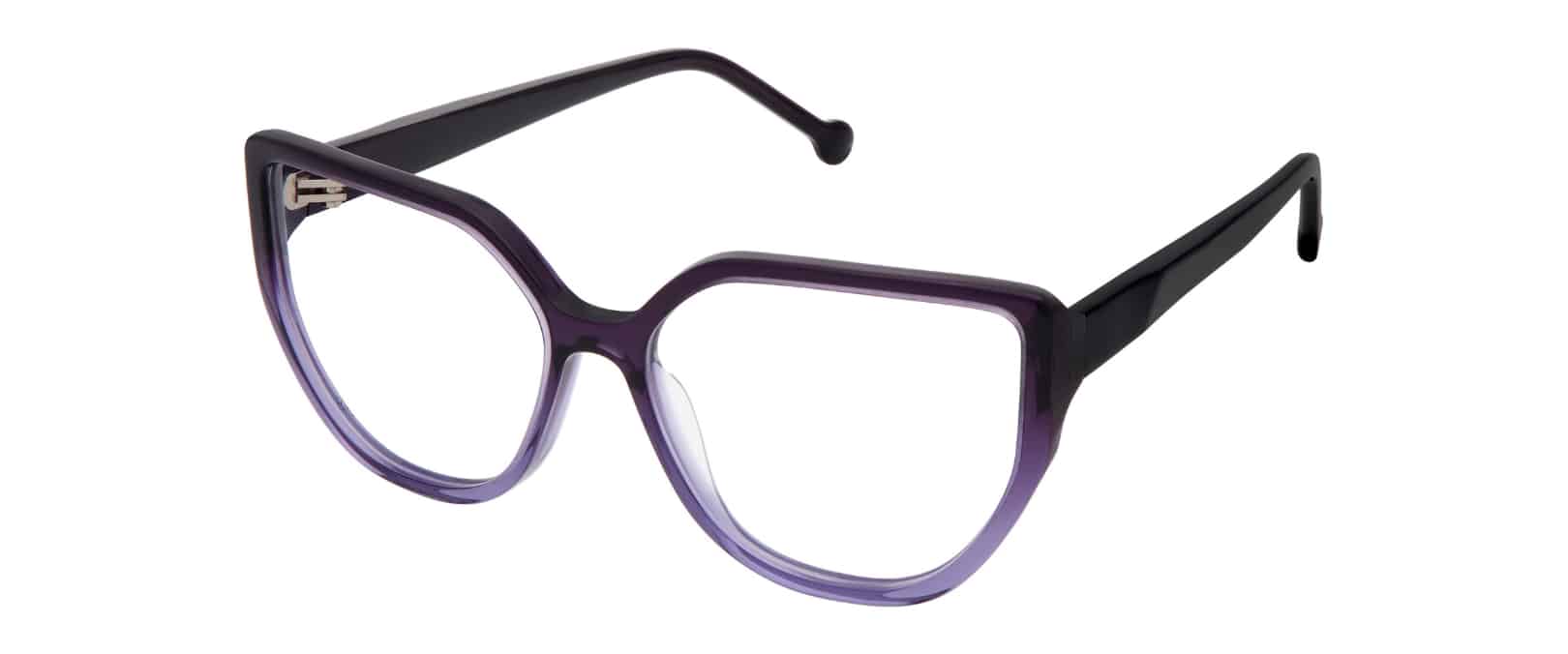
Claire Goldsmith has introduced eight new models to its Legacy collection. The Segal features a dark-coloured front to which has been added a bright-coloured line (e.g., indigo on black). Victory is a translucid acetate frame in various tints, such as Smoke Screen, Amber Honey and Black on English Tea. The Hampstead sunglass model, which is part of the Sun collection by Oliver Goldsmith, is another new addition. www.clairegoldsmith.com
Tura launches Lulu Guinness models
Lulu Guinness has launched four new cat-eye sunglass models for women (L114, L117, L122, L123). The new styles feature crystals, enameling and Italian prints from the designer’s handbag collection. Retailers who pre-order the new styles and have them delivered before year-end will receive special promotional pricing. Model 117 is inspired by the retro Club Master shape and has been modified as an oval with a cat-eye corner. The Wild Cat printed pattern is used on the brow and temples. http://www.tura.com/
EyeCheck shortlisted for prestigious James Dyson award
EyeCheck, a start-up founded by University of Waterloo students, made the final list of 20 entries for the James Dyson Award.
The James Dyson Award (named after the inventor of the Dyson bagless vacuum cleaner) is a design engineering award. The winning student or team receives $46,000, and their university receives $18,000.
Developed by Ashutosh Syal and Daxal Desai, two University of Waterloo systems design engineering grads, EyeCheck aims to bring inexpensive eye care to developing countries using a smartphone app developed for BlackBerry 10.
The app takes a picture of the person’s face, tells you whether the person is nearsighted or farsighted, and detects opacity in their eyes. You can then take a picture of the eye itself to provide a prescription, which must nonetheless be confirmed by an optometrist. This device reduces a 20-minute exam to about three minutes.
For now, the team is focussed on developing prototypes. Its members intend to conduct trials in “eye care camps” held in developing countries. “It is one thing to work with a charity here in Canada sitting over a cup of coffee, and something totally different talking to a volunteer on the ground in India,” said Ashutosh Syal.
Source: http://www.insidehalton.com/news-story/4919630-dyson-award-has-eyes-for-waterloo-startup/
A first in Canada: two patients receive the Argus II implant
Two patients at the Toronto Western Hospital have become the first in Canada to receive the Argus II Retinal Prosthesis Device.
Both patients lost their vision due to retinitis pigmentosa. The prosthesis will not restore their sight, but will allow them to once again perceive light.
A prosthesis the size of a pencil eraser is implanted into the retina. Then each patient is given a pair of glasses with a built-in video camera. Information from the camera is wirelessly transmitted to electrodes in the implant and converted to electrical pulses. These pulses are turned into images, which are transmitted to the brain. The patient must undergo intensive rehabilitation to learn how to process these images.
The implants have already produced results. Orly Shamir, one of the patients, can detect a moving square on a computer screen, which she was unable to see at all before. She can also see the movement of a line across the screen, as well as black and white stripes on a board.
“The device stimulates the retina the same way that light normally does, just electronically,” said Dr. Robert Devenyi, a member of the team of physicians who performed the surgery.
Source: http://www.ctvnews.ca/health/bionic-eye-implants-let-canadian-patients-perceive-light-1.2052819