fbpx

Valeant buys Bausch + Lomb

The Quebec pharmaceutical Valeant has acquired Bausch + Lomb, the global leader in eye health, for $8.7 billion.


Half of the payment will go directly to the investor group led by Warburg Pincus, which bought B + L in 2007 for $4.5 billion, while the other half will be used to repay B + L’s outstanding debt. To finance the acquisition, Valeant will issue $2 billion in new equity and borrow the rest.


Valeant will integrate its ophthalmology businesses into the new division, which will retain the name Bausch + Lomb. The pharmaceutical company expects to achieve $800 million in cost savings by 2014. B + L distributes such products as Vision Care, ONEday, PureVision, along with the Besivance, Lotemax, and Ocuvite treatments.


There have been rumours for months that Bausch + Lomb was being sold, but when it came time to discuss potential buyers, names like Abbott Laboratories, Johnson & Johnson, and Sanofi, even Merck & Co and Pfizer, were frontrunners, as ClipInfo.ca reported on January 8, 2013. More recently, in February, Warburg Pincus was considering the initial public offering route to unload B + L, saying it was disappointed in the bids it had received.


 

Source: http://ir.valeant.com/investor-relations/news-releases/news-release-details/2013/Valeant-Pharmaceuticals-International-Inc-To-Acquire-Bausch–Lomb-For-87-Billion/default.aspx

Wearing an eye patch longer corrects amblyopia

Wearing an eye patch six hours a day instead of two hours is much more effective after a 10-week period. Now to convince the children…


Researchers from the Pediatric Eye Disease Investigator (PEDI) group tested this strategy in 167 children whose amblyopia failed to improve after 12 weeks of two hours daily eye patching. After comparing a group that continued to wear the patch two hours a day with another group that wore the patch six hours a day, the researchers found significant differences. The visual acuity in 75% of children in the second group improved two lines or more on a standard test (with glasses).


The study shows that more eye patch time improves visual acuity. “Instead of starting with two hours and increasing, you could say if we want to achieve the optimum outcome in the shortest possible time, let’s start with a higher dose in the first place,” said Dr. Alistair Fielder, from City University, London.

Source: http://www.medscape.com/viewarticle/802876


Small animals answer big questions

Did primates develop three-colour vision because they began to live in the day or did they begin to live in the day due to the appearance of this trait? A small animal with bulging eyes – the tarsier – may hold the answer to this question.


American scientists analyzed the genes that encode photopigments in the eye of the tarsier, a small primate that branched off early on from monkeys, apes, and humans. They showed that the last common ancestor of living tarsiers had three-colour vision similar to that of monkeys and apes. However, they had enlarged eyes, suggesting they were active at night.


According to the researchers, this shows that tarsiers first adapted to dim light levels, such as twilight or the full moon. These light conditions were dark enough to favour large eyes but still bright enough to support trichromatic colour vision. This compromise would have helped the primates switch to daytime living, which allowed them to better see their prey, their predators, and other primates and to expand their territory.


Source: http://www.sciencedaily.com/releases/2013/03/130327132537.htm


Large eyes of Neanderthals

A British study shows that compared to the modern human brain, the brain structure of Neanderthals focussed much larger areas on vision and movement. This difference could have contributed to their extinction.


Neanderthals’ brains were similar in size to those of modern humans, but their eyes were larger. Having larger brain areas related to vision and movement meant that there was less room left over to deal with the social interactions required for life in large groups.


“Smaller social groups might have made Neanderthals less able to cope with the difficulties of their harsh Eurasian environments because they would have had fewer friends to help them out in times of need,” explains lead author Eiluned Pearce from the University of Oxford. “Overall, differences in brain organisation and social cognition may go a long way towards explaining why Neanderthals went extinct whereas modern humans survived.”


The same researchers had previously shown that humans living in higher latitudes had more areas of the brain dedicated to vision in order to cope with low light levels. They offer the hypothesis that Neanderthals would have developed larger eyes because they evolved in Europe, while their contemporary humans originated from Africa.


Source:  http://www.sciencedaily.com/releases/2013/03/130319093639.htm

Featured Posts

The Vision Council logo

New Research Finds Most Adults with Eye Strain Symptoms Skip Professional Care

A new Vision Council report shows most adults with digital eye strain symptoms never seek care, underscoring the importance of eyecare providers in guiding patients.

Learn More
Mido awards 2027 logos

Applications Open for MIDO AWARDS 2027

Applications are now open for the MIDO AWARDS 2027, including the CSE Award, CSE Corporate Award and Best Store Award, recognizing sustainability, innovation and excellence across the global optical industry.

Read more
Optometry Giving Sight logo a turquoise eye with black icons in the shape of people for the iris

Four Miles to Clear Vision

Kevin rode four miles to a Healing California Pop-Up Vision Clinic supported by OGS, where he received a full exam and prescription bifocals at no cost—improving his safety, independence, and quality of life.

Read more
Optometry Giving Sight logo a turquoise eye with black icons in the shape of people for the iris

Optometry Giving Sight Provides Nearly $1M in Global Program Funding

Optometry Giving Sight has awarded nearly $1 million in 2026 grants to 20 organizations worldwide, supporting sustainable optometry education, school eye health programs, and community-based primary eye care across six continents.

Read more
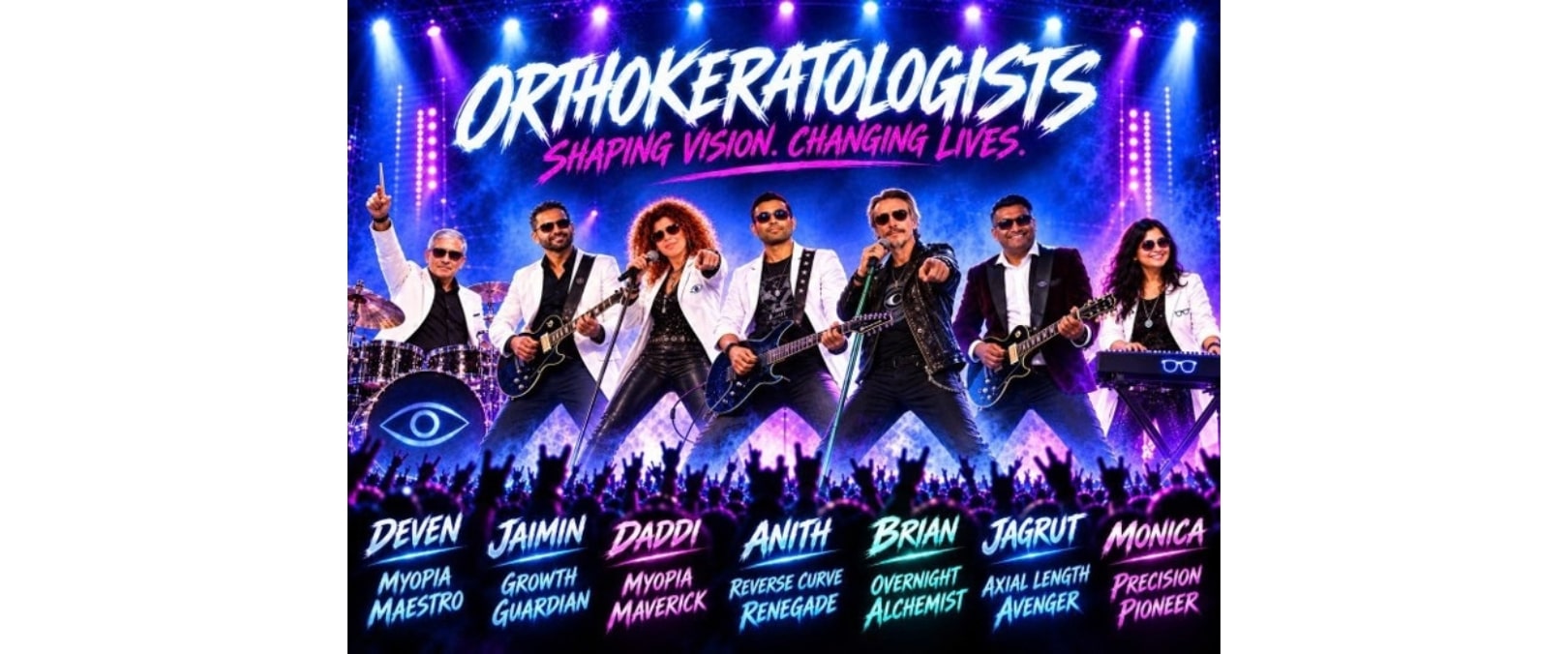
Orthokeratologists ROCKSTARS’ PRE-LAUNCH CAMPAIGN

Orthokeratologist.org Launches Global Community to Unite Orthokeratologists Worldwide

Orthokeratologist.org launches the first global community for orthokeratologists, inviting practitioners worldwide to register, connect and help advance the future of ortho k.

Read more
The Vision Council logo

New Research Finds Most Adults with Eye Strain Symptoms Skip Professional Care

A new Vision Council report shows most adults with digital eye strain symptoms never seek care, underscoring the importance of eyecare providers in guiding patients.

Learn More
Mido awards 2027 logos

Applications Open for MIDO AWARDS 2027

Applications are now open for the MIDO AWARDS 2027, including the CSE Award, CSE Corporate Award and Best Store Award, recognizing sustainability, innovation and excellence across the global optical industry.

Read More
Optometry Giving Sight logo a turquoise eye with black icons in the shape of people for the iris

Four Miles to Clear Vision

Kevin rode four miles to a Healing California Pop-Up Vision Clinic supported by OGS, where he received a full exam and prescription bifocals at no cost—improving his safety, independence, and quality of life.

Read More
Optometry Giving Sight logo a turquoise eye with black icons in the shape of people for the iris

Optometry Giving Sight Provides Nearly $1M in Global Program Funding

Optometry Giving Sight has awarded nearly $1 million in 2026 grants to 20 organizations worldwide, supporting sustainable optometry education, school eye health programs, and community-based primary eye care across six continents.

Read More
Orthokeratologists ROCKSTARS’ PRE-LAUNCH CAMPAIGN

Orthokeratologist.org Launches Global Community to Unite Orthokeratologists Worldwide

Orthokeratologist.org launches the first global community for orthokeratologists, inviting practitioners worldwide to register, connect and help advance the future of ortho k.

Read More
The Vision Council logo

New Research Finds Most Adults with Eye Strain Symptoms Skip Professional Care

A new Vision Council report shows most adults with digital eye strain symptoms never seek care, underscoring the importance of eyecare providers in guiding patients.

Learn More
Mido awards 2027 logos

Applications Open for MIDO AWARDS 2027

Applications are now open for the MIDO AWARDS 2027, including the CSE Award, CSE Corporate Award and Best Store Award, recognizing sustainability, innovation and excellence across the global optical industry.

Read more
Optometry Giving Sight logo a turquoise eye with black icons in the shape of people for the iris

Four Miles to Clear Vision

Kevin rode four miles to a Healing California Pop-Up Vision Clinic supported by OGS, where he received a full exam and prescription bifocals at no cost—improving his safety, independence, and quality of life.

Read more
Optometry Giving Sight logo a turquoise eye with black icons in the shape of people for the iris

Optometry Giving Sight Provides Nearly $1M in Global Program Funding

Optometry Giving Sight has awarded nearly $1 million in 2026 grants to 20 organizations worldwide, supporting sustainable optometry education, school eye health programs, and community-based primary eye care across six continents.

Read more
Orthokeratologists ROCKSTARS’ PRE-LAUNCH CAMPAIGN

Orthokeratologist.org Launches Global Community to Unite Orthokeratologists Worldwide

Orthokeratologist.org launches the first global community for orthokeratologists, inviting practitioners worldwide to register, connect and help advance the future of ortho k.

Read more
The Vision Council logo

New Research Finds Most Adults with Eye Strain Symptoms Skip Professional Care

A new Vision Council report shows most adults with digital eye strain symptoms never seek care, underscoring the importance of eyecare providers in guiding patients.

Learn More
Mido awards 2027 logos

Applications Open for MIDO AWARDS 2027

Applications are now open for the MIDO AWARDS 2027, including the CSE Award, CSE Corporate Award and Best Store Award, recognizing sustainability, innovation and excellence across the global optical industry.

Read more
Optometry Giving Sight logo a turquoise eye with black icons in the shape of people for the iris

Four Miles to Clear Vision

Kevin rode four miles to a Healing California Pop-Up Vision Clinic supported by OGS, where he received a full exam and prescription bifocals at no cost—improving his safety, independence, and quality of life.

Read more
Optometry Giving Sight logo a turquoise eye with black icons in the shape of people for the iris

Optometry Giving Sight Provides Nearly $1M in Global Program Funding

Optometry Giving Sight has awarded nearly $1 million in 2026 grants to 20 organizations worldwide, supporting sustainable optometry education, school eye health programs, and community-based primary eye care across six continents.

Read more
Orthokeratologists ROCKSTARS’ PRE-LAUNCH CAMPAIGN

Orthokeratologist.org Launches Global Community to Unite Orthokeratologists Worldwide

Orthokeratologist.org launches the first global community for orthokeratologists, inviting practitioners worldwide to register, connect and help advance the future of ortho k.

Read more