On June 14th in the House of Commons, Hon. Judy Sgro, MP for Humber River-Black Creek, introduced Bill C-284 to establish a National Strategy for Eye Care.
Fighting Blindness Canada applauds this step. For years, Fighting Blindness Canada in partnership with other vision organizations including Canadian Council of the Blind, CNIB, Vision Loss Rehabilitation Canada, Diabetes Canada, Canadian Association of Optometrists and Canadian Ophthalmological Society have advocated for a National Vision Health Plan. This plan is necessary to focus energy and resources on eye health and the impact that vision loss has for health and well-being.
When introducing the Bill, Mrs. Sgro said “Mr. Speaker, I am very happy today to have the opportunity to introduce this bill calling for a national strategy on eye care, something that, for many years, Canadians have been calling for, and something that the government has promised many times before that.
I want to acknowledge that I am introducing this bill in memory of my grandmother, Annie Steeves, and I continue to see my aunt Ruby Gentile and my long-time friend and mentor Paul Valenti, who suffer from blindness.”
Mrs. Sgro cited the over eight million Canadians living with a blinding eye disease as why the House needs to pass this Bill. “I ask all of my colleagues to just imagine how their lives would change if they lost their eyesight. We take it for granted, and we do not stop to think enough. Over eight million people currently live with a blinding eye disease that puts them at risk, and these numbers are expected to grow to almost 14 million people.”
“Many of us currently in the House may also develop macular degeneration, and I would like to see February designated as macular degeneration awareness month.” Mrs. Srgo continued.
“The Canadian Council of the Blind, Fighting Blindness Canada, CNIB and countless other organizations have been calling for an eye strategy for Canada, to move forward with the commitment made previously to develop a national eye strategy that will protect the eye health of all Canadians.”
The Bill’s first reading motion was adopted and the Bill will now move to a second reading. Fighting Blindness Canada urges you to write to your M.P. to encourage them to support the Bill.
One-third of Ontarians haven’t had an eye exam in over three years, and 55% feel as though eyewear is currently not affordable for Canadians, a recent poll found. That’s why Specsavers is announcing an investment of $50 million into Ontario to enhance eye health outcomes, reduce preventable blindness and redefine accessible eye care.
“Our Government is pleased to welcome Specsavers to Ontario,” said Vic Fedeli, Minister of Economic Development, Job Creation and Trade. “This $50 million investment will create 1500 jobs for the people of Ontario and is further proof that by lowering the cost of doing business by $7 billion each and every year, we have made our province a more attractive place to invest.”
This investment is aimed at creating business ownership opportunities for opticians and independent optometrists, helping them to achieve success while remaining autonomous and patientcare focused.
“Specsavers’ investment into Ontario aligns with our purpose of changing lives through better sight,” said Bill Moir, General Manager, Specsavers Canada. “Seventy-five per cent of vision loss and blindness is preventable or treatable with early intervention. With Specsavers’ global scale, we are able to lower the cost of eyewear for Ontarians, which helps remove a significant barrier to getting regular eye exams, especially at a time when Ontarians are being more careful with their money due to rising costs.”
Specsavers Canada is focused on following the clinical evidence from Specsavers in Australia, where consistent use of OCT as part of standard care has enabled a significant increase in early detection and management of conditions like glaucoma. This ensures patients are made aware of any risks they have so their condition can be managed preventatively before vision is lost.
Specsavers’ investment into Ontario is part of a $100 million investment plan for Canada, which was announced earlier this year to open 200 locations across the country. This multi-million-dollar investment will cover 100% of location start-up costs for optometrists and opticians who become Specsavers business owners. All optometry clinics and optical stores will be locally owned, creating new jobs and allowing owners to focus on the specific needs of their community.
The IMI survey titled ‘Myopia Control Attitudes and Practice’ builds upon data gathered in 2016 and 2019 to establish adoption of the latest evidence addressing the myopia epidemic and how it varies geographically and among ECPs.
World Council of Optometry President Peter Hendicott, MAppSc, PhD said, “We encourage eye care professionals worldwide to take this survey whether or not they employ myopia management in their practices.
The World Council of Optometry fully supports our colleagues at the International Myopia Institute in gathering this critical information to learn more about what is happening in practices around the world and how we can get ahead of the myopia epidemic.”
International Myopia Institute Chair, Professor Serge Resnikoff, said, “Receiving feedback directly from eye care practitioners would help IMI to identify areas that need further knowledge dissemination and understand factors that could hinder practitioners from adopting best practices.”
The IMI global practitioner survey is available in the following languages:
The survey is open to eye care professionals worldwide and is scheduled to close in October 2022. Results are expected to be tabulated and reported in early 2023.
The IMI survey promotion is one aspect of WCO’s ongoing collaboration with CooperVision, now in its second year, to advance myopia management as the standard of care worldwide.
Survey finds Canadians aren’t wearing sunglasses enough, which can increase risk of cataracts
Many Canadians love basking in the sun during the long-awaited summer months, but they’re not taking enough precautions to protect their eyes from damaging UV rays that can lead to cataracts, one of the four leading eye diseases. In time for UV Safety Awareness Month, a joint survey from the Canadian Ophthalmological Society and the Canadian Association of Optometrists reveals that just two-thirds of Canadians regularly wear sunglasses on a sunny day (64 per cent) or during the summer months (63 per cent), and only 33 per cent wear them all year long. If left untreated, cataracts can cause blindness.
“It’s important to protect our eyes from harmful UV rays all year long to decrease the risk of developing cataracts later in life,” says Dr. Phil Hooper, President of the Canadian Ophthalmological Society. “While this eye disease is more common in people over 60, young people are still at risk, so taking the necessary precaution now will only help decrease their chances of getting this eye disease in the future.”
The survey also revealed that younger Canadians may not be taking enough precaution in protecting their eyes from harmful UV rays. Only a third of respondents say that their children regularly wear sunglasses on a sunny day (33 per cent) or during the summer months (32 per cent), and only 13 per cent say their children wear them on a cloudy day, despite the fact that UV rays are still present.
Over 2.5 million people in Canada are living with cataracts, and while the eye disease is most common in people over the age of 60, changes to the lens generally start around the age of 40.
ZEISS ClearView Single Vision lenses represent a milestone in optics and aesthetics of Standard Single Vision lenses
Standard single vision (SV), whether spherical (SPH) or aspherical (AS) is the most sold ophthalmic lens type worldwide. Now ZEISS has identified a way to get many attributes of complex single vision freeform lens designs into both stock FSV lenses and standard SV surfaced lenses. The result is ZEISS ClearView Single Vision lenses. It offers high optical quality in order to provide clear vision from the lens center to the periphery and is very thin and flat at the same time.
A closer look at different single vision lens designs
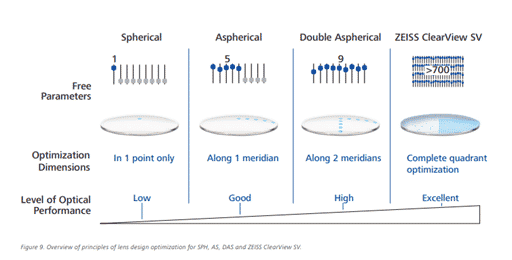
To get a better understanding of this ZEISS innovation, it makes sense to take a closer look at single vision lens designs. The choice of lens design impacts the aesthetics, comfort of the lens, and optical performance. Spherical (SPH) single vision lenses, for example, are typically optimized using only one free parameter (the radii of curvature of the lens surface). Aspheric (AS) single vision lenses have a more complex shape. Typically, the lens front surface is optimized with a low number of free parameters in one meridian. Double aspherical single vision lenses are generally optimized using twice the number of free parameters. But in summary, all these lens designs do not adequately address the peripheral optics of most prescriptions.
In the 1990s ZEISS pioneered freeform lens design technology in surfaced lenses – which are made to order. And now it is also ZEISS that has introduced single vision freeform lens design to improve the optics and aesthetics of the SV lens category. This is possible due to a specially created freeform lens design for FSV and the new ClearForm manufacturing process that incorporates this design into the finished lens. The lens design includes point-by-point optimization with the use of around 700 free parameters across the lens. This ClearForm process utilizes the latest computer numerically controlled (CNC) generators that use special diamond cutting and polishing tools to surface the complex shaped molds for ZEISS ClearView FSV lenses. The final lens delivers, on average, a three times larger zone of excellent clear vision,[1] to provide the wearer with more clarity from the lens center to the periphery. It is therefore designed to deliver a higher level of comfort and satisfaction for the eyeglasses wearer. In addition, the complex lens shapes allow wearers to experience this vision clarity in a flatter and thinner lens than conventional SV lens designs that rely on steeper base curves to provide just acceptable optical performance. In numbers, this means: ZEISS SV ClearView lenses are on average 34 percent flatter across all prescriptions and up to 16 percent thinner compared to typical spherical single vision lenses.[2],[3]
Principles of lens design optimization for spherical, aspherical, double aspherical and ZEISS ClearView SVs.
“ZEISS is transforming the single vision market by bringing many aspects of freeform lens design to the SV lens category,” explains Bryan Rossi, the President of Zeiss Vision Care Canada. “Freeform lens design combined with the ClearForm technology used in ZEISS ClearView SV enables complex lens shapes that were previously only possible in surfaced single vision lenses. ZEISS now offers premium quality optics in finished single vision lenses, combined with fast delivery and affordable pricing to ensure everyone can access the benefits of ZEISS optics,” adds Maryam Karbalaei, the Marketing Manager of Zeiss Vision Care Canada.
[1] Based on a visual clarity simulation on a 50 mm diameter lens area for 1.60 index ZEISS FSV ClearView lenses compared to 1.60 ZEISS AS FSV lenses. Average of +5 D, +3 D, +1 D, -1 D, -3 D, -5 D, and -7 D with and without a cylinder of -2 D. Quantitative analyses by Technology & Innovation, Carl Zeiss Vision GmbH, 2020.
[2] Measurements of lens flatness (base curve) on 1.60 ZEISS ClearView FSV lenses compared to ZEISS Spherical FSV lenses. Average of -5, -3, -1, +1, +3, +5 D with and without cyl -2 D. Maximum reduction of 49% of -5.00 D with and without -2 D cyl for minus lenses. Maximum reduction of 25% of 5.00 D with and without 2 D cyl for plus lenses. Quantitative analyses by Technology & Innovation, Carl Zeiss Vision GmbH, DE, 2020.
[3] Measurements of lens thickness on 1.60 ZEISS ClearView FSV lenses compared to ZEISS spherical FSV lenses over a range of prescriptions (-5, -3, -1, +1, +3, +5 D with and without cyl -2 D). Maximum reduction of 16% for center thickness of +5.00/-2.00. Quantitative analyses by Technology & Innovation, Carl Zeiss Vision GmbH, DE, 2020.
Orthokeratologist.org launches the first global community for orthokeratologists, inviting practitioners worldwide to register, connect and help advance the future of ortho k.
SightGlass Vision will host a Canadian webinar exploring real world pediatric cases and evidence supporting contrast based myopia control using DOT spectacle lenses.
HOYA Vision Care launches LensPreview in Canada, a virtual try on tool that lets patients preview photochromic, polarized and mirror lenses in true to colour detail, enhancing confidence and supporting practice growth.
Italian eyewear exports declined in early 2026 due to U.S. market weakness, but Europe’s resilience and improving monthly trends signal gradual recovery.
Orthokeratologist.org launches the first global community for orthokeratologists, inviting practitioners worldwide to register, connect and help advance the future of ortho k.
SightGlass Vision will host a Canadian webinar exploring real world pediatric cases and evidence supporting contrast based myopia control using DOT spectacle lenses.
HOYA Vision Care launches LensPreview in Canada, a virtual try on tool that lets patients preview photochromic, polarized and mirror lenses in true to colour detail, enhancing confidence and supporting practice growth.
Italian eyewear exports declined in early 2026 due to U.S. market weakness, but Europe’s resilience and improving monthly trends signal gradual recovery.
Orthokeratologist.org launches the first global community for orthokeratologists, inviting practitioners worldwide to register, connect and help advance the future of ortho k.
SightGlass Vision will host a Canadian webinar exploring real world pediatric cases and evidence supporting contrast based myopia control using DOT spectacle lenses.
HOYA Vision Care launches LensPreview in Canada, a virtual try on tool that lets patients preview photochromic, polarized and mirror lenses in true to colour detail, enhancing confidence and supporting practice growth.
Italian eyewear exports declined in early 2026 due to U.S. market weakness, but Europe’s resilience and improving monthly trends signal gradual recovery.
Orthokeratologist.org launches the first global community for orthokeratologists, inviting practitioners worldwide to register, connect and help advance the future of ortho k.
SightGlass Vision will host a Canadian webinar exploring real world pediatric cases and evidence supporting contrast based myopia control using DOT spectacle lenses.
HOYA Vision Care launches LensPreview in Canada, a virtual try on tool that lets patients preview photochromic, polarized and mirror lenses in true to colour detail, enhancing confidence and supporting practice growth.
Italian eyewear exports declined in early 2026 due to U.S. market weakness, but Europe’s resilience and improving monthly trends signal gradual recovery.